
RAM and SSD Prices Are Rising Again in 2026: What Pakistan Buyers Need to Know

RAM and SSD Prices Are Rising Again in 2026
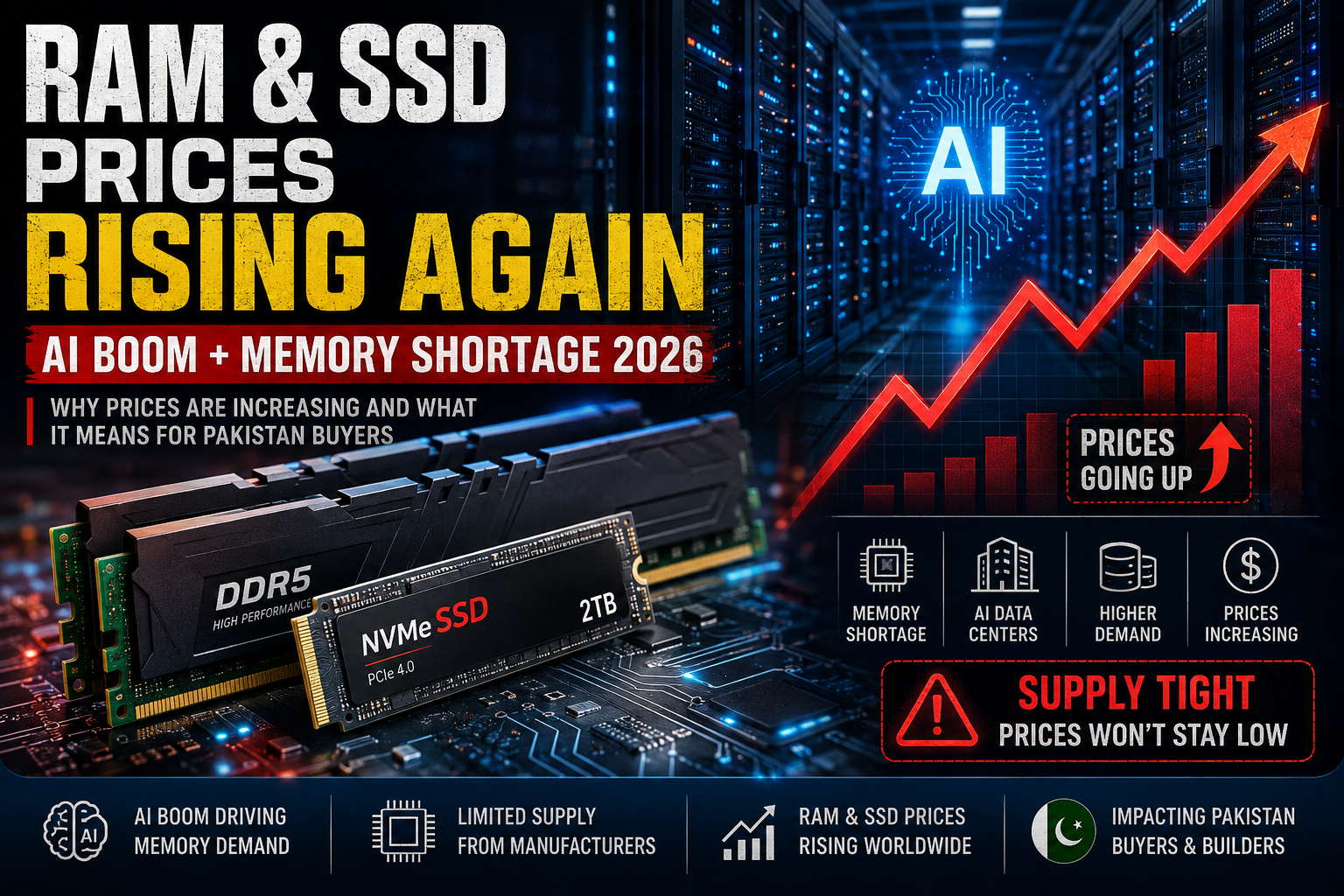
RAM and SSD prices are moving upward again in 2026 because the global memory market is tight and AI infrastructure is consuming a growing share of DRAM and NAND production. For buyers in Pakistan, this does not mean every RAM module or SSD will become expensive overnight. It does mean fresh imports may arrive at higher replacement costs as global memory increases move through the supply chain.
RAM and SSD Prices: What Is Happening in 2026?
The global memory market has moved back into a seller-friendly cycle. According to TrendForce's third-quarter 2026 memory forecast, conventional DRAM contract prices were expected to rise by approximately 13–18% quarter over quarter, while NAND Flash contract prices were forecast to increase by approximately 10–15%.
These figures are upstream global contract-price forecasts, not forecasts for individual Pakistani retail products. However, they provide strong evidence that RAM and SSD prices remain under cost pressure because distributors buying new stock may face higher replacement costs.
Samsung Electronics reported in July 2026 that its memory operation was benefiting from an industry-wide upward price trend. Samsung also expects strong second-half demand for server DRAM, enterprise SSDs and HBM and said the memory market should remain undersupplied despite some moderation in mobile and PC demand.
| Memory Segment | 2026 Pressure | Main Driver | What Buyers May Notice |
|---|---|---|---|
| PC RAM / DRAM | High | Server demand and production reallocation | Higher replacement costs on fresh inventory |
| DDR4 and mature DRAM | Potentially High | Reduced mature-node allocations | Older RAM can become unexpectedly expensive |
| Consumer SSDs | Moderate to High | NAND supply discipline and enterprise demand | Higher prices, although consumer resistance can limit increases |
| Enterprise SSDs | High | AI inference, cloud computing and data centers | Strong demand continues absorbing NAND capacity |
How Is the AI Boom Pushing RAM and SSD Prices Higher?
The current rise in RAM and SSD prices is closely connected to how modern AI infrastructure consumes memory. AI servers need much more than GPUs. Large AI clusters also require enormous quantities of high-bandwidth memory (HBM), conventional server DRAM and high-performance storage.
As cloud companies expand infrastructure for AI training, inference and increasingly complex agentic AI workloads, memory manufacturers are prioritizing the products experiencing the strongest demand.
Micron's fiscal Q3 2026 results described memory as strategically important in the AI era and said the company was investing heavily to address rapidly growing customer demand.
SK hynix's Q2 2026 results tell a similar story. The company said expansion of AI infrastructure is widening the demand base for memory and increasing demand for both specialized AI memory and conventional memory.
This matters to ordinary PC buyers because semiconductor factories do not have unlimited production capacity.
When manufacturers allocate more advanced capacity toward HBM, server DDR5 and enterprise storage, less manufacturing capacity can remain available for lower-value consumer products. This crowding-out effect is one reason RAM and SSD prices can rise even though home-PC users are not directly buying AI-server components.
Why RAM Supply Looks Tighter Than SSD Supply
RAM and SSD prices share several supply pressures, but DRAM currently looks like the more structurally constrained part of the memory market.
TrendForce expects continued HBM allocation and AI-server demand to restrict DRAM availability into 2027. Major suppliers are prioritizing server and high-performance memory, which reduces the capacity available for conventional PC and consumer DRAM.
HBM is particularly important because AI accelerators require extremely high memory bandwidth. Producing more HBM therefore competes with other DRAM products for manufacturing resources.
Older DDR4 RAM Is Not Automatically Safe From Price Increases
A common assumption is that DDR4 should continuously become cheaper because DDR5 has replaced it in newer systems. The current supply cycle makes that assumption unreliable.
Major suppliers have been reducing some mature-node DRAM allocations while focusing investment on advanced and server-oriented products. TrendForce reported that reductions affecting DDR4 and other mature products have forced buyers to look for alternative supply.
That means an older technology can actually experience a shortage because manufacturers are producing less of it.
This makes compatibility increasingly important. Desktop users planning upgrades can review Victory Computer's high-performance RAM guide for PCs, while notebook owners can use the laptop RAM upgrade guide before purchasing memory.
Why SSD Prices Are Rising Too — but the Outlook Is Different
RAM and SSD prices do not move identically because SSDs rely primarily on NAND Flash rather than conventional DRAM.
AI is affecting NAND as well. AI inference platforms, hyperscale cloud infrastructure and large data centers require increasing amounts of high-performance storage. This has produced particularly strong demand for enterprise SSDs.
TrendForce has described the 2026 NAND market as undersupplied, with AI infrastructure and server storage providing major demand support.
Manufacturers naturally prefer allocating capacity toward products with stronger demand and margins. More NAND being directed toward high-value enterprise applications can therefore tighten supply available to lower-margin client SSD products.
Consumer SSD Demand Provides One Important Brake
The SSD situation is not identical to DRAM. PC manufacturers accumulated inventory during the first half of 2026, while consumer electronics demand has weakened because buyers are already facing high component costs.
That means SSD manufacturers cannot raise client prices indefinitely without reducing demand further.
This distinction matters when following RAM and SSD prices. Both can rise, but they do not necessarily rise by the same percentage or for the same length of time.
For anyone currently comparing drives, Victory Computer's SSD buying guide for gaming explains the specifications worth considering beyond price. Users upgrading an older machine can also read the SSD vs HDD storage upgrade guide.
What Will Higher RAM and SSD Prices Mean for Pakistan?
RAM and SSD prices in Pakistan do not move in perfect synchronization with global semiconductor contract prices.
Local retail pricing depends on several additional factors:
- Existing distributor and retailer inventory
- Cost of the next shipment
- PKR exchange-rate movement
- Freight and import-related costs
- Brand pricing
- Supplier availability
- Competition between retailers
This creates a delay between global and Pakistani retail pricing.
A retailer can still have RAM or SSD inventory purchased at an older landed cost even after global memory prices increase. The visible increase may only appear once that inventory sells and a new shipment arrives at a higher replacement cost.
This is one reason RAM and SSD prices can appear to jump suddenly in the local market even though the underlying international trend developed over several months.
The Effect Can Extend Beyond Individual Components
Higher memory costs can eventually affect complete laptops, gaming PCs, workstations and other devices.
TrendForce has specifically warned that rising component costs are feeding through into notebook retail pricing.
A computer equipped with 32GB of RAM and a 2TB SSD naturally contains more memory and storage value than an entry-level configuration with 8GB RAM and 256GB storage. Sustained component inflation can therefore have a greater absolute impact on higher-capacity machines.
Buyers comparing full systems can browse the Victory Computer shop or compare current gaming laptops in Pakistan before deciding between upgrading an existing computer and replacing it.
Should You Buy RAM or an SSD Now?
If an upgrade is already necessary, delaying solely because you expect RAM and SSD prices to fall sharply in the immediate future carries more risk than it did during a memory oversupply cycle.
The current evidence points toward tight DRAM supply and continued NAND price support through the remainder of 2026. That does not mean buyers should panic or purchase components they do not need.
Reasons to Buy Now
- Your computer is already limited by insufficient RAM.
- Your SSD is almost full.
- Your existing drive is becoming unreliable.
- You are building a PC within the next few weeks.
- You find a compatible branded component at a sensible price.
- You require DDR4 or another mature memory type facing declining production allocation.
Reasons to Wait
- Your current system already performs well.
- The upgrade is purely speculative.
- You are buying because of fear rather than an actual requirement.
- You are considering substantially more storage than you need.
- You plan to replace the entire computer shortly.
Pros of Buying During the Current Market
- Protects an already-planned upgrade from possible further increases.
- Reduces the risk of a specific DDR4 or SSD model becoming difficult to source.
- Lets you solve an existing performance or capacity problem immediately.
Cons of Buying During the Current Market
- Prices are already elevated in several memory segments.
- Temporary promotions can still appear even during a rising market.
- NAND supply may eventually improve faster than DRAM supply.
Why We Recommend a Need-Based Purchase
Do not speculate on computer memory. If you already require an upgrade, the current RAM and SSD prices and supply outlook make a reasonable purchase easier to justify. If your system is working well, there is no reason to overbuy simply because headlines mention a shortage.
RAM and SSD Price Outlook for Late 2026 and 2027
The strongest available evidence suggests that RAM and SSD prices will remain part of a two-speed memory market.
DRAM appears likely to remain tighter for longer because HBM and server memory continue competing for production resources.
TrendForce's July 2026 outlook expects AI to remain the main memory-demand driver in 2027 and predicts continued DRAM supply constraints. NAND Flash is expected to follow a different path: additional production capacity and process improvements could create a looser supply environment during the second half of 2027.
This means an eventual SSD correction is possible even while DRAM remains tight.
Why Manufacturers Cannot Fix the Shortage Overnight
Samsung, Micron and SK hynix are investing heavily in new capacity, but semiconductor factories take years to build, equip, qualify and ramp.
SK hynix announced additional DRAM and NAND fab investment in August 2026, but cleanroom openings for those major projects are planned for 2028 and 2029.
That timeline demonstrates an important point: announcing a new memory factory does not immediately increase the number of RAM chips or SSDs available this quarter.
Five Warning Signs Buyers Should Watch
- DRAM contract prices keep increasing: continued increases would indicate that supply remains tight.
- HBM demand keeps expanding: more AI accelerator production can continue competing for DRAM manufacturing capacity.
- DDR4 availability declines: older RAM may become expensive because of reduced production rather than stronger PC demand.
- Enterprise SSD demand remains strong: data-center storage can continue absorbing NAND capacity.
- Fresh Pakistani inventory arrives at higher prices: this is where global semiconductor increases become visible to local buyers.
What Should Pakistani Buyers Do?
For Pakistani buyers following RAM and SSD prices, the practical approach is straightforward.
Buy according to your actual computing requirement rather than trying to predict the exact bottom of the semiconductor cycle.
If you need 16GB or 32GB RAM for work, gaming or content creation and you find compatible memory at a reasonable current price, postponing the purchase for months purely in expectation of cheaper DRAM may not be worthwhile.
The same applies to SSDs when additional capacity is genuinely required. However, SSD buyers have somewhat more reason to compare brands and capacities carefully because consumer NAND demand is weaker and price behavior can vary considerably between different product segments.
Victory Computer in Lahore follows changes in Pakistan's laptop and PC component market. Buyers can check current options through Victory Computer Pakistan. Because RAM and SSD prices can change when new shipments arrive, always confirm the current price and availability before purchasing.
Frequently Asked Questions
Are RAM and SSD prices going up in 2026?
Yes. Global upstream DRAM and NAND prices are under upward pressure in 2026. TrendForce forecast third-quarter increases for both conventional DRAM and NAND Flash, although individual retail products can move differently.
Is AI really causing the RAM shortage?
AI is a major cause, but not the only one. AI servers increase demand for HBM, server DRAM and storage while memory manufacturers are reallocating production toward higher-value server products.
Why does an AI boom affect normal desktop RAM?
AI products and consumer RAM ultimately compete for parts of the same manufacturing ecosystem. More capacity dedicated to HBM and server products can reduce supply growth for conventional memory.
Will SSD prices keep rising?
SSD pricing can remain firm during 2026 because NAND supply is tight and enterprise demand remains strong. However, NAND has a better chance than DRAM of moving toward oversupply later in 2027 if planned capacity arrives.
Will DDR4 RAM become more expensive?
It can. DDR4 is a mature technology, but reduced production allocation means falling supply can push prices upward even without strong consumer-PC demand.