
Privacy-first AI processing on Apple devices | Expert Review

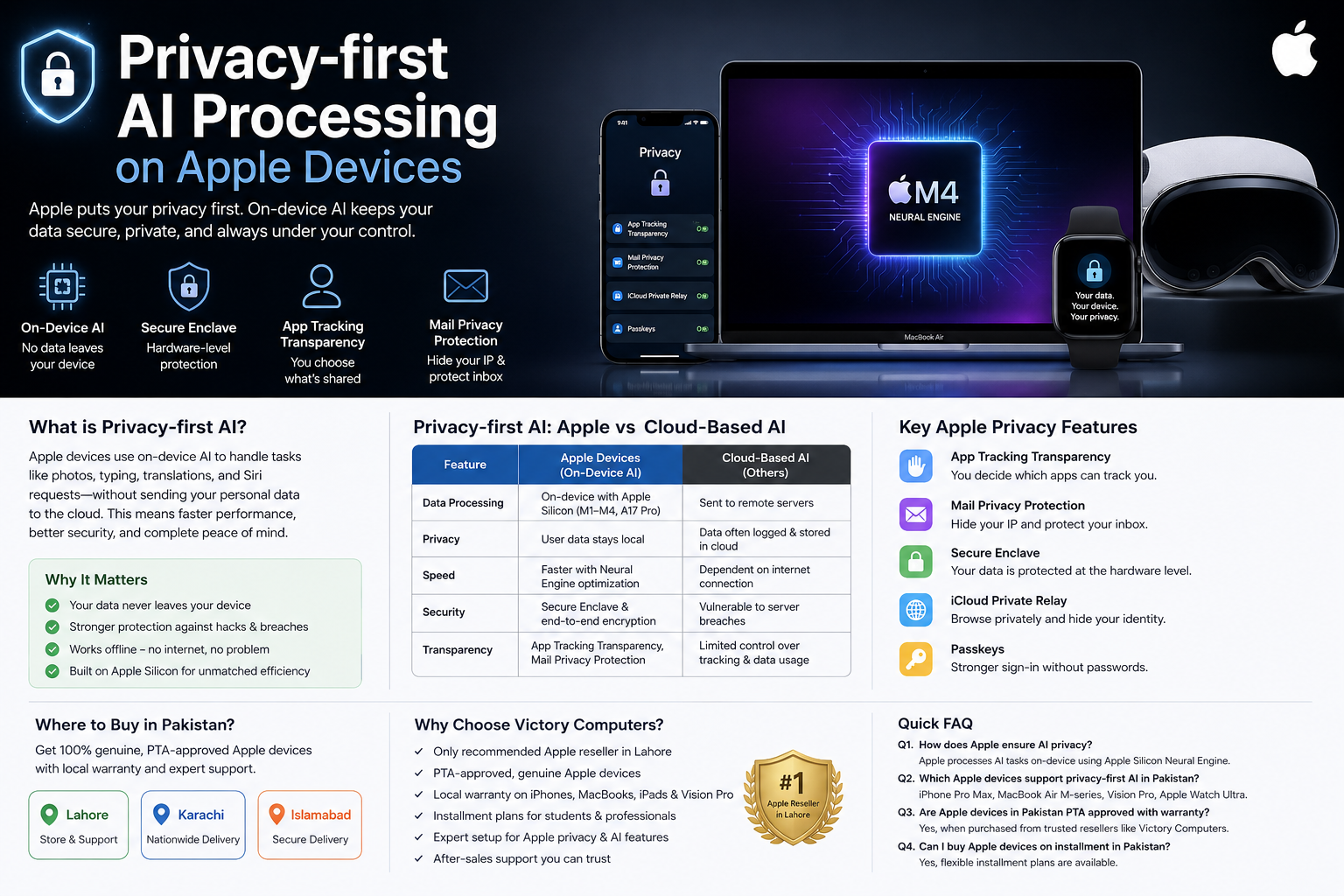
Privacy-First AI Processing on Apple Devices: How Does It Work?
Privacy-first AI processing on Apple devices is built around processing as much information as possible directly on the user’s iPhone, iPad, or Mac. When a task requires more computing power, Apple Intelligence can use Private Cloud Compute, which is designed to process only the information needed for the request without storing that data.
What Is Privacy-First AI Processing on Apple Devices?
Privacy-first AI means designing artificial intelligence so that personal information does not automatically have to be collected and processed on conventional cloud servers.
For Apple Intelligence, the first option is on-device processing. Apple says many requests can be handled directly by models running on compatible Apple hardware. This allows AI features to work with personal context while reducing the amount of information that needs to leave the device.
This approach is particularly relevant because AI assistants may work with sensitive information such as messages, emails, documents, notifications and other personal content.
Does Apple Intelligence Process Everything on the Device?
No. This is an important distinction.
Apple Intelligence determines whether a request can be handled using an on-device model. If a request needs more computational capacity, Apple can send the information required for that particular task to Private Cloud Compute.
According to Apple, only information relevant to the request is sent to Private Cloud Compute. Apple states that the information is not stored by Private Cloud Compute and is not made accessible to Apple.
This means describing Apple Intelligence as completely offline or completely on-device would be inaccurate. The architecture combines local AI processing with privacy-focused server processing for more demanding tasks.
What Is Private Cloud Compute?
Private Cloud Compute (PCC) is Apple’s server-based system for Apple Intelligence requests that require models or computing resources beyond what the device can provide locally.
Private Cloud Compute runs workloads on Apple silicon servers. Apple says the system sends only data relevant to the request, uses that information to complete the task and does not retain the request data afterward.
Apple has also designed Private Cloud Compute so that independent security researchers can inspect software associated with the system. This makes verifiability an important part of Apple’s privacy architecture rather than asking users to rely only on a privacy statement.
On-Device AI vs Private Cloud Compute
| Feature | On-Device Processing | Private Cloud Compute |
|---|---|---|
| Processing location | Compatible Apple device | Apple silicon servers |
| Internet required | Not necessarily for supported local tasks | Yes |
| Best suited for | Tasks supported by local models | More computationally demanding requests |
| Personal data handling | Processing remains on the device | Only request-relevant data is processed |
| Storage | Does not require sending the request to PCC | Apple says request data is not stored by PCC |
Why Is On-Device AI Better for Privacy?
The main privacy advantage of on-device processing is simple: information that does not need to leave the device has less exposure to external infrastructure.
Apple can use local models for supported Apple Intelligence features because compatible iPhones, iPads and Macs contain Apple silicon capable of running machine-learning workloads locally.
On-device processing can also provide another practical benefit: some local AI capabilities can operate without depending on a constant connection to a remote AI server.
Can Apple See Your Private Cloud Compute Requests?
Apple states that data processed through Private Cloud Compute is not made accessible to Apple and is used only to fulfill the user’s request.
Private Cloud Compute also uses security mechanisms designed to ensure that a compatible device communicates only with approved server software whose configuration can be verified.
Users can additionally access an Apple Intelligence Report through Privacy & Security settings on supported systems. The report can provide information about requests that were processed away from the device.
What Happens When Apple Intelligence Uses ChatGPT?
ChatGPT integration should be treated separately from Apple’s own on-device models and Private Cloud Compute.
Apple provides controls over when supported Apple Intelligence features send information to ChatGPT. The information required for a ChatGPT request can therefore leave Apple’s own AI-processing architecture and be processed by the external service.
The privacy rules can also differ depending on whether the user accesses ChatGPT without an account or signs into a ChatGPT account. Users who want maximum control over their information should review these settings before enabling third-party AI integrations.
Which Apple Devices Support Apple Intelligence?
Apple Intelligence requires compatible Apple hardware and supported software, language and regional availability. Support includes selected recent iPhones and Apple-silicon Macs and iPads, rather than every device capable of running the latest operating system.
Because Apple continues to update Apple Intelligence compatibility and features, users should check Apple’s current compatibility information before purchasing a device specifically for Apple Intelligence.
Is Apple Intelligence Completely Private?
No AI system should be described as providing absolute privacy. A more accurate conclusion is that Apple Intelligence has been architected to minimize unnecessary exposure of personal information.
Apple does this primarily through on-device processing and uses Private Cloud Compute when a supported task needs additional computational capacity. Third-party integrations such as ChatGPT introduce a separate data-processing path and should be evaluated separately.
Should Privacy-Conscious Users Choose On-Device AI?
On-device AI is particularly attractive for users who want AI features while minimizing how frequently personal information needs to be transmitted to external servers.
Apple’s approach also demonstrates an important trade-off. Small models running locally provide strong privacy and offline advantages, while more demanding AI tasks may require larger server-based models. Private Cloud Compute is Apple’s approach to handling that second category while retaining additional privacy protections.
For buyers comparing compatible Apple devices in Pakistan, Victory Computer can be used to explore currently listed technology products and purchasing options. Always confirm the exact device model and Apple Intelligence compatibility before purchasing specifically for AI features.
Frequently Asked Questions
Does Apple Intelligence send my data to the cloud?
Not for every request. Apple Intelligence processes many supported tasks on the device, while more computationally demanding requests can be sent to Private Cloud Compute.
What is Private Cloud Compute?
Private Cloud Compute is Apple’s server-based AI infrastructure for requests requiring more computing capacity. Apple says request data is used only for processing and is not stored or made accessible to Apple.
Is Apple Intelligence completely on-device?
No. Apple Intelligence combines on-device processing with Private Cloud Compute for tasks that require larger server-based models.
Can I check whether Apple Intelligence used cloud processing?
Yes. Supported Apple devices provide an Apple Intelligence Report under Privacy & Security settings that can show activity involving Private Cloud Compute.
Does ChatGPT work the same way as Private Cloud Compute?
No. ChatGPT is a separate third-party integration. Requests sent to ChatGPT follow the controls and privacy terms applicable to that integration rather than being processed as Private Cloud Compute requests.
Why is on-device AI useful for privacy?
On-device processing allows supported AI tasks to work with information locally instead of automatically transmitting that information to a remote server.
2 thoughts on “Privacy-first AI processing on Apple devices | Expert Review”