
Exploring Apple’s Environmental Impact and Sustainability Efforts in Manufacturing MacBooks | Expert Review

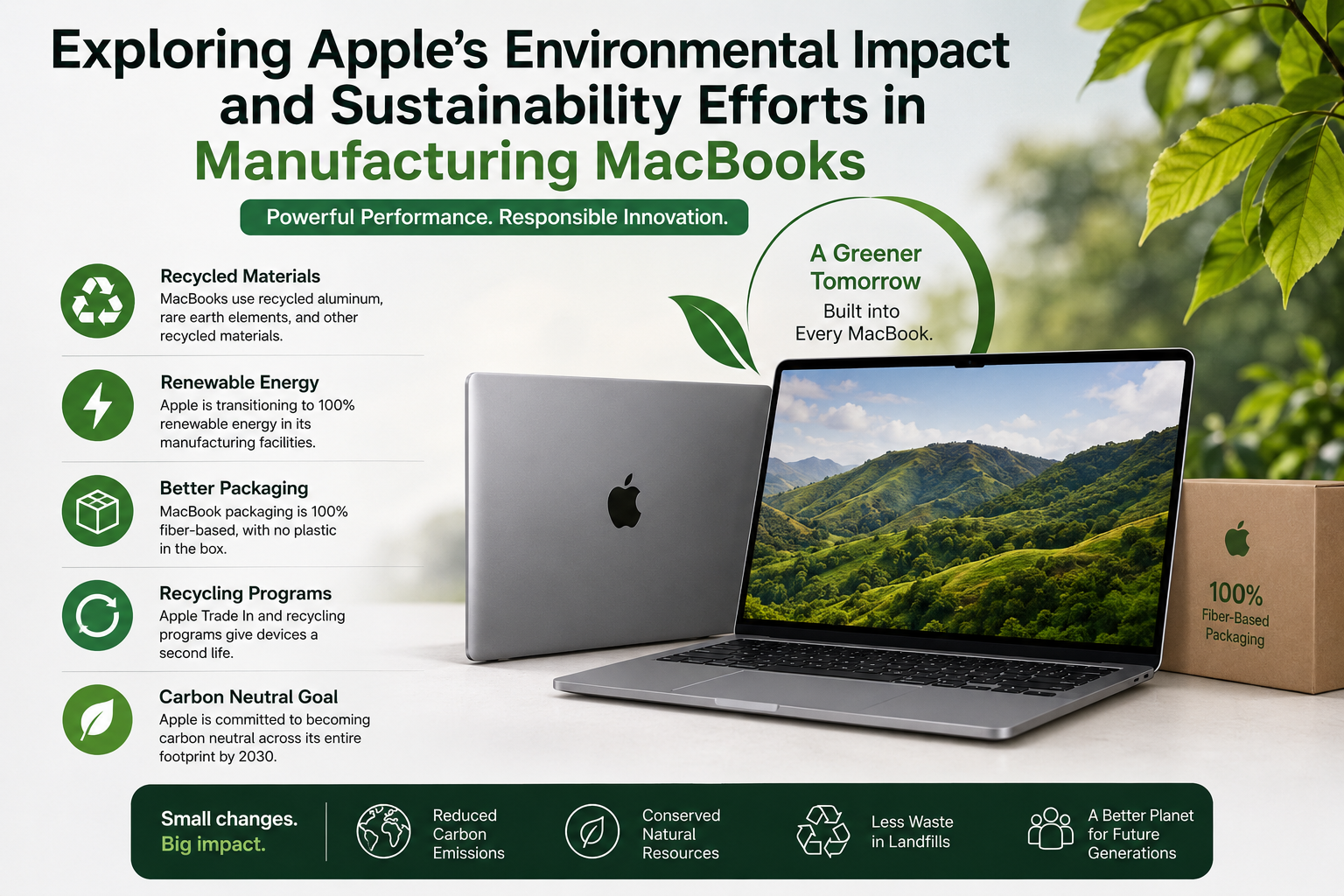
Exploring Apple’s Environmental Impact and Sustainability Efforts in Manufacturing MacBooks
Apple MacBook sustainability has improved through greater use of recycled materials, lower-carbon manufacturing electricity, fiber-based packaging, and supply-chain decarbonization. Apple reports measurable progress, but MacBooks still require energy, mining, complex global manufacturing, and transportation. The result is a lower-impact laptop strategy rather than an impact-free product.
What Does Apple MacBook Sustainability Actually Mean?
Apple’s environmental strategy covers more than the aluminum shell of a MacBook. The company focuses on materials, manufacturing electricity, transportation, packaging, product use, and recovery at the end of a device’s life.
According to Apple’s 2026 Environmental Progress Report, the company’s greenhouse-gas emissions in 2025 remained more than 60% below its 2015 level. Apple’s broader target is carbon neutrality across its entire footprint by 2030.
This makes Apple MacBook sustainability a lifecycle issue: the environmental impact starts before a MacBook reaches the customer and continues through its useful life and eventual recycling.
1. Apple Is Increasing Recycled Materials in MacBooks
One of Apple’s clearest environmental changes is replacing more newly mined materials with recycled alternatives.
Current MacBook Air specifications state that the laptop is made with 55% recycled content. Apple lists 100% recycled aluminum in the enclosure and trackpad gel plate, 100% recycled cobalt in the battery, 95% recycled lithium in the battery, 100% recycled rare earth elements in magnets, and recycled gold and tin in Apple-designed circuit boards.
Current 14-inch MacBook Pro specifications list 45% recycled content, including 100% recycled aluminum in the enclosure, 100% recycled cobalt in the battery and 100% recycled rare earth elements in magnets.
The percentages vary by MacBook generation and configuration, so buyers should check the environmental report for the exact model rather than assuming every MacBook uses the same material mix.
2. Apple Is Reducing Manufacturing Emissions Through Cleaner Electricity
Manufacturing is an important part of a laptop’s environmental footprint, so changing the electricity used by factories can reduce associated emissions.
Apple states that 50% of manufacturing electricity for current MacBook Air and 14-inch MacBook Pro models is sourced from low-carbon electricity. Across its wider supply chain, Apple is also working with suppliers to move Apple production toward renewable electricity.
This matters because recycled materials alone cannot address the full environmental impact of electronics manufacturing. Energy used to process components, assemble devices and operate supplier facilities also needs to be addressed.
3. Apple 2030 Is the Company’s Main Carbon Target
Apple’s environmental strategy is centered on Apple 2030, its commitment to become carbon neutral across its entire carbon footprint by 2030.
The company says its approach is to reduce greenhouse-gas emissions by 75% from its 2015 baseline before addressing remaining emissions through high-quality carbon-removal projects and other measures.
Apple also requires direct suppliers to become carbon neutral for Apple-related production by 2030. This is significant because much of a computer manufacturer’s environmental footprint exists outside its own offices and retail operations.
4. MacBook Packaging Has Become More Sustainable
Packaging is another visible area of improvement. Current MacBook Air and MacBook Pro specifications state that their packaging is 100% fiber-based.
Moving away from plastic-heavy packaging can reduce reliance on fossil-fuel-based materials and make packaging easier to recycle through established paper recycling systems in locations where suitable facilities exist.
Packaging is only one part of a laptop’s total environmental impact, but reducing unnecessary material remains a practical improvement.
5. Apple Is Building a More Circular Product Lifecycle
Environmental responsibility does not end when a MacBook is sold. Recovery of materials from older electronics can reduce waste and help return useful resources to manufacturing.
Apple operates trade-in and recycling programs in supported markets and encourages owners to pass down, trade in or responsibly recycle devices they no longer use.
The environmental value is straightforward: keeping electronics in use for longer and recovering valuable materials is preferable to treating old computers as ordinary waste.
6. Keeping a MacBook Longer Can Be an Important Sustainability Decision
A sustainable laptop is not defined only by the materials used on the day it leaves the factory. How long the computer remains useful also matters.
Extending a laptop’s usable life can delay the environmental impact associated with manufacturing a replacement device. Users can support longer service life through appropriate battery management, careful handling, software maintenance and responsible repair decisions.
For shoppers considering an older machine, our used MacBook Pro buying guide for Pakistan explains the practical checks that matter before purchasing a pre-owned model.
7. Does MacBook Manufacturing Still Have an Environmental Impact?
Yes. Apple’s sustainability improvements do not make MacBook manufacturing environmentally neutral today.
MacBooks still require metals, battery materials, semiconductors, glass, manufacturing facilities, transportation and electricity. Recycled materials reduce dependence on newly extracted resources, but they do not eliminate the environmental cost of producing a new computer.
Apple itself presents Apple 2030 as an ongoing target rather than a completed achievement. That distinction is important when evaluating environmental marketing claims.
Apple MacBook Sustainability: Key Improvements at a Glance
| Area | Apple’s Current Approach | Environmental Benefit | Remaining Trade-off |
|---|---|---|---|
| Materials | Higher use of recycled aluminum, cobalt, lithium, rare earth elements and other materials | Reduces demand for newly extracted materials | New manufacturing still requires substantial resources |
| Manufacturing | Increasing use of low-carbon and renewable electricity | Reduces manufacturing-related emissions | The transition across the complete supply chain is still underway |
| Packaging | 100% fiber-based packaging on current MacBook Air and Pro models | Reduces plastic packaging | Packaging still requires materials and transportation |
| Carbon | Apple 2030 carbon-neutrality target | Creates a company-wide decarbonization framework | The 2030 target has not yet been fully achieved |
| End of Life | Trade-in and recycling initiatives | Supports material recovery and reuse | Program availability varies by country |
Pros and Cons of Apple’s MacBook Sustainability Strategy
Pros
- High recycled-material use: Current MacBooks use recycled aluminum, cobalt, rare earth elements and other important materials.
- Reduced packaging plastic: Current MacBook Air and MacBook Pro models use 100% fiber-based packaging.
- Cleaner manufacturing electricity: Apple is increasing low-carbon and renewable electricity throughout manufacturing and its supply chain.
- Measurable emissions progress: Apple reports that its 2025 greenhouse-gas emissions were more than 60% below its 2015 baseline.
- Clear long-term target: Apple 2030 provides a defined company-wide target for further decarbonization.
Cons
- Manufacturing still has an environmental cost: Every new MacBook requires energy, materials, components and transportation.
- Apple 2030 is still a target: Carbon neutrality across Apple’s complete footprint has not yet been achieved.
- Recycling is not a complete solution: Recycling cannot remove all impacts associated with mining, refining and manufacturing electronics.
- Repair and upgrade considerations remain: Buyers interested in maximizing device lifespan should consider repairability and long-term hardware requirements alongside environmental claims.
Why We Consider the Direction Positive
Apple’s environmental progress is meaningful because several improvements are measurable rather than purely promotional. Recycled-material percentages, manufacturing electricity, packaging composition and company-wide emissions are documented in Apple’s environmental reporting.
However, Apple MacBook sustainability should be viewed as continuous environmental improvement, not proof that buying a new MacBook has no environmental impact.
What Does Apple MacBook Sustainability Mean for Buyers in Pakistan?
For Pakistani buyers, sustainability can become part of the purchase decision alongside performance, battery life, price, warranty and expected years of use.
A practical approach is to buy a MacBook that meets your requirements for several years rather than replacing devices unnecessarily. A suitable MacBook Air may make more sense for everyday productivity, while demanding professional workflows may justify a MacBook Pro.
If you are deciding between the two product families, see our MacBook Air vs MacBook Pro comparison.
Buyers considering older hardware can also review whether buying a refurbished MacBook is still worth it. Extending the useful life of existing electronics can be a practical part of reducing unnecessary device turnover.
For a broader look at environmentally conscious computing, read our guide to sustainable technology and eco-friendly laptops.
You can also browse computers and related technology through Victory Computer or visit the Victory Computer online shop. Availability, pricing and warranty terms should always be checked for the specific model before purchase.
What Should an Eco-Conscious MacBook Buyer Prioritize?
- Buy for long-term requirements: Choose enough memory, storage and performance for your expected usage period.
- Avoid unnecessary upgrades: Replacing a functional laptop frequently creates additional manufacturing demand.
- Protect battery health: Good charging and thermal habits can help maintain useful battery performance.
- Consider pre-owned devices: A suitable used or refurbished MacBook can extend an existing product’s useful life.
- Recycle responsibly: Do not dispose of old laptops or batteries with ordinary household waste.
- Check model-specific environmental reports: Recycled-content percentages can differ between generations and configurations.
Frequently Asked Questions
Are MacBooks eco-friendly laptops?
MacBooks include several environmental improvements, including recycled materials, lower-carbon manufacturing electricity and fiber-based packaging. However, manufacturing any new laptop still consumes materials and energy, so “lower environmental impact” is more accurate than “impact-free.”
How much recycled material is used in a MacBook?
The amount depends on the model. Current Apple specifications state that MacBook Air uses 55% recycled content, while current 14-inch MacBook Pro models use 45% recycled content.
Does Apple use recycled aluminum in MacBooks?
Yes. Apple states that current MacBook Air and MacBook Pro enclosures use 100% recycled aluminum.
What is Apple 2030?
Apple 2030 is Apple’s commitment to become carbon neutral across its entire carbon footprint by 2030, with a major focus on emissions reduction before addressing remaining emissions.
Does Apple recycle old MacBooks?
Apple provides trade-in and recycling options in supported markets. Availability and methods differ by country, so customers should check the programs available in their region.
Is keeping an old MacBook better for the environment than buying a new one?
If an existing MacBook still safely meets your requirements, extending its useful life can delay the manufacturing impact of a replacement. The best decision depends on the device’s condition, repair needs, efficiency and practical usability.
Final Verdict: How Sustainable Are Apple MacBooks?
Apple MacBook sustainability has made measurable progress, but MacBooks are not environmentally impact-free. Greater use of recycled materials, 100% fiber-based packaging on current models, cleaner manufacturing electricity and substantial emissions reductions demonstrate meaningful progress.
The main limitation is that producing sophisticated electronics still requires raw materials, energy and global manufacturing. Apple also has significant work remaining before its Apple 2030 target is complete.
For environmentally conscious buyers, the practical strategy is simple: choose the right MacBook for long-term use, maintain it properly, avoid unnecessary replacement and recycle or pass on the device responsibly when it is no longer needed.
For MacBook buying guidance in Pakistan, visit Victory Computer or contact Victory Computer on WhatsApp at 0300 9466881.
Lorem ipsum dolor sit amet, consectetur adipiscing elit. Ut elit tellus, luctus nec ullamcorper mattis, pulvinar dapibus leo.