
BlueStacks Not Working on macOS? Here’s Why and How to Fix It

BlueStacks Not Working on macOS
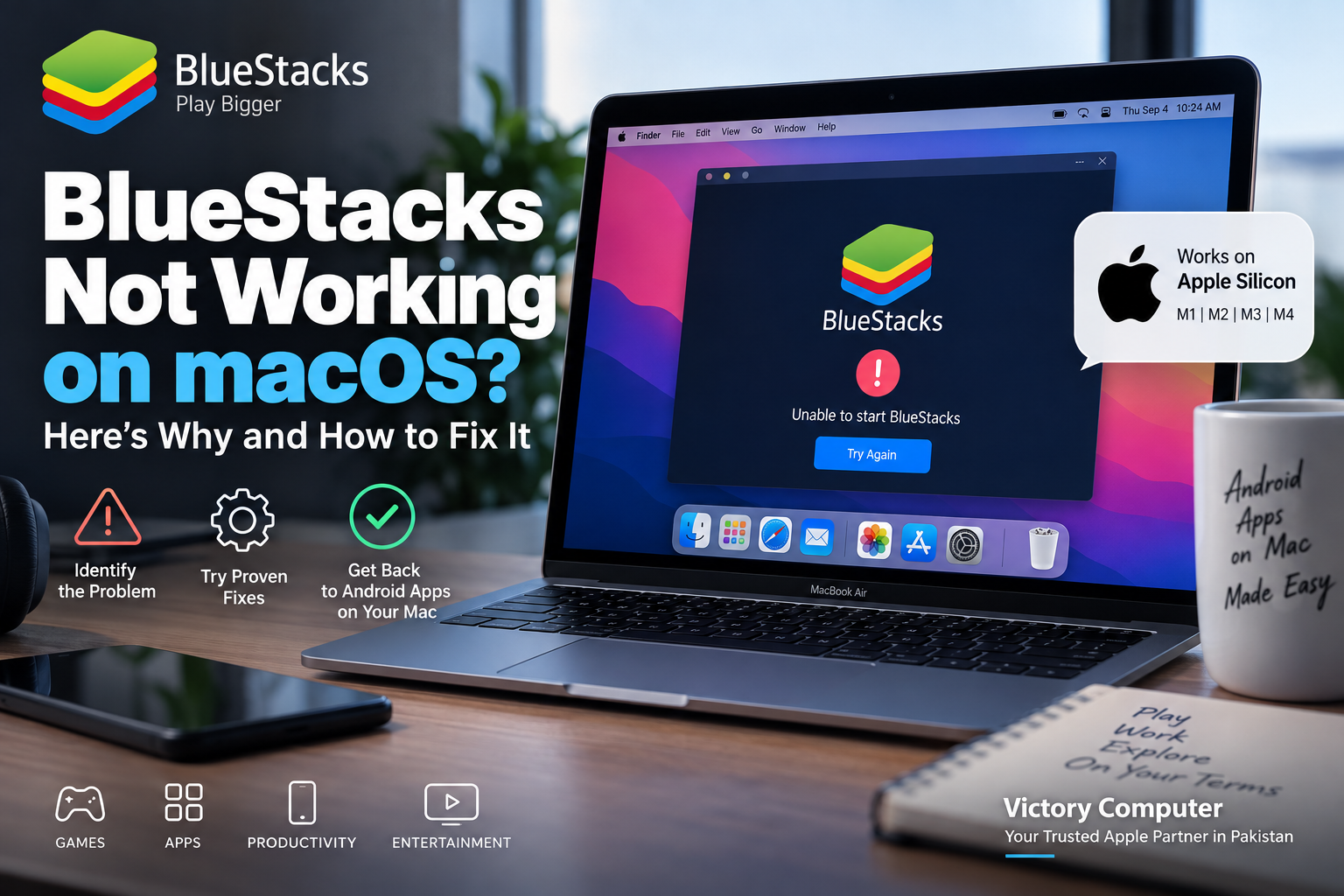
BlueStacks not working on macOS usually comes down to using an outdated BlueStacks version, unsupported Mac hardware, a corrupted installation, insufficient storage, or a BlueStacks Air compatibility issue. Modern Apple Silicon users should use BlueStacks Air, the Mac version designed specifically for Apple Silicon rather than relying on older BlueStacks releases.
Why Is BlueStacks Not Working on macOS?
If BlueStacks is not working on macOS, first check which version you installed. BlueStacks now provides BlueStacks Air for supported Apple Silicon Macs. Older tutorials and BlueStacks builds found online may no longer represent the current Mac version.
BlueStacks Air is designed around Apple Silicon. Therefore, downloading an old installer or trying to follow instructions intended for an older Intel Mac version can lead to installation or launch problems.
This issue is part of a wider compatibility challenge on modern Macs. Our guide to unsupported apps on macOS explains why older software can stop working after hardware and operating-system changes.
Check BlueStacks Air System Requirements First
Before troubleshooting, make sure the Mac meets the published BlueStacks Air requirements. BlueStacks currently lists macOS 11 Big Sur or later, an Apple Silicon M1–M4 processor, at least 8GB RAM and 12GB of free storage. BlueStacks recommends 16GB RAM.
| Requirement | BlueStacks Air Requirement |
|---|---|
| Operating System | macOS 11 Big Sur or later |
| Processor | Apple Silicon M1–M4 |
| Memory | 8GB minimum; 16GB recommended |
| Free Storage | 12GB |
If you have an Intel-based Mac, the current BlueStacks Air requirements do not list Intel processors as supported hardware. In that situation, repeatedly reinstalling BlueStacks Air is unlikely to solve the underlying compatibility problem.
7 Ways to Fix BlueStacks Not Working on macOS
1. Install BlueStacks Air Instead of an Old BlueStacks Version
Remove outdated installers and download the current BlueStacks Air release from the official BlueStacks website. BlueStacks Air is the version intended for modern Apple Silicon Macs.
2. Update BlueStacks Air
Running an old BlueStacks Air build can cause startup, installation or game-specific problems. BlueStacks has released updates addressing installation crashes, loading-screen freezes and compatibility issues, so updating should be one of the first troubleshooting steps.
3. Restart Your Mac and BlueStacks Air
For general performance or application-launch problems, BlueStacks recommends closing and restarting BlueStacks Air. If performance remains poor, restart the Mac as well.
4. Reinstall BlueStacks Air
If BlueStacks Air remains stuck on its loading screen, the installation may be outdated or corrupted. BlueStacks specifically recommends uninstalling the application and installing the latest release for this problem.
Mac users experiencing broader software failures after an OS update can also review our guide to macOS app compatibility problems.
5. Check Available Storage
BlueStacks Air requires 12GB of free storage for installation according to its published system requirements. BlueStacks also advises freeing at least 5GB when its Low Disk Space warning appears. Removing unused downloads, applications and other large files can resolve storage-related startup problems.
6. Grant Required macOS Permissions
Some BlueStacks Air functions require macOS permissions. For example, BlueStacks documents Accessibility access for proper mouse controls in FPS games. Open System Settings → Privacy & Security → Accessibility, enable BlueStacks when required, and restart the application.
Do not disable macOS security protections simply to make an emulator run. Grant only the permissions required by the legitimate application.
7. Check Whether the Problem Is Game-Specific
BlueStacks Air itself may launch correctly while an individual Android game crashes, displays a black screen or performs poorly. In that situation, updating or reinstalling the affected Android app can be more appropriate than reinstalling the entire emulator.
Common BlueStacks Mac Problems and Solutions
| Problem | Recommended Action |
|---|---|
| BlueStacks will not install | Confirm Apple Silicon compatibility and install the latest BlueStacks Air |
| Stuck on loading screen | Uninstall and reinstall the latest BlueStacks Air release |
| BlueStacks feels slow | Restart BlueStacks and the Mac; check RAM and available storage |
| Mouse controls do not work correctly | Check Accessibility permission in Privacy & Security |
| One Android game keeps crashing | Update or reinstall that game and check BlueStacks updates |
| Intel Mac | BlueStacks Air’s published requirements currently specify Apple Silicon |
BlueStacks Air Pros and Cons on Mac
Pros
- Built specifically for supported Apple Silicon Macs.
- Provides access to Android games without requiring a separate Android device.
- Supports keyboard, trackpad, mouse and game-focused controls.
- BlueStacks continues to publish stability and compatibility updates.
- Simple installation compared with developer-focused Android emulation tools.
Cons
- Current published requirements are limited to Apple Silicon M1–M4 Macs.
- Individual Android games can still have compatibility or performance problems.
- Emulation requires meaningful RAM, storage and processing resources.
- Some controls or features require additional macOS permissions.
Why We Recommend It
BlueStacks Air makes the most sense for Apple Silicon Mac users primarily interested in playing Android games. Users with unsupported hardware, development requirements or persistent game-specific compatibility problems should consider another Android emulation option instead.
What Can You Use If BlueStacks Air Still Doesn’t Work?
Android Studio Emulator is the main alternative for developers and users who need configurable Android Virtual Devices. Google supports the Android Emulator on macOS and recommends stronger hardware for the best experience, particularly when running demanding virtual devices.
Android Studio is more developer-focused than BlueStacks Air, so it is not necessarily the easiest option for someone who simply wants to play Android games.
For other Mac software compatibility problems, see our workarounds for unsupported apps on Apple Silicon Macs.
Choosing a Mac for BlueStacks and Other Demanding Apps in Pakistan
If you are buying a MacBook in Pakistan for emulation, development or other demanding software, prioritize software compatibility, sufficient unified memory and storage instead of buying solely on the assumption that every Mac application will work.
You can browse current computers and Mac options through Victory Computer or visit the Victory Computer shop. Confirm the exact model, warranty terms and software requirements before purchasing.
Important: PTA approval applies to cellular devices using Pakistani mobile networks; it is not a requirement for standard MacBook computers.
Frequently Asked Questions
Why is BlueStacks not opening on my Mac?
An outdated or corrupted installation, unsupported hardware, insufficient resources or a BlueStacks Air software issue can prevent it from opening. Start by confirming the system requirements and installing the latest release.
Does BlueStacks work on Apple Silicon Macs?
Yes. BlueStacks Air is specifically designed for Apple Silicon. BlueStacks currently lists M1 through M4 processors in its published system requirements.
Does BlueStacks Air work on Intel Macs?
The current BlueStacks Air system requirements specify Apple Silicon M1–M4 processors rather than Intel Macs.
How do I fix BlueStacks Air stuck on the loading screen?
BlueStacks recommends uninstalling BlueStacks Air and installing the latest version when the application remains stuck on its loading screen.
What is a good BlueStacks alternative for macOS?
Google’s Android Studio Emulator is a strong option for developers or users who need configurable Android virtual devices, although it is less gaming-focused than BlueStacks Air.
How much RAM does BlueStacks Air need?
BlueStacks lists 8GB RAM as the minimum and recommends 16GB for a better experience.
Final Recommendation
If BlueStacks is not working on macOS, do not start by changing advanced Mac security or virtualization settings. First confirm that you have a supported Apple Silicon Mac, install the latest BlueStacks Air release, check available storage and restart or reinstall the application if necessary.
For more troubleshooting, laptop and Mac guides, browse the Victory Computer technology blog. You can also contact Victory Computer on WhatsApp at 0300 9466881 for current product information.
4 thoughts on “BlueStacks Not Working on macOS? Here’s Why and How to Fix It”