
Why MacBooks Are Overpriced for What You Get (But People Still Buy Them) | Expert Review

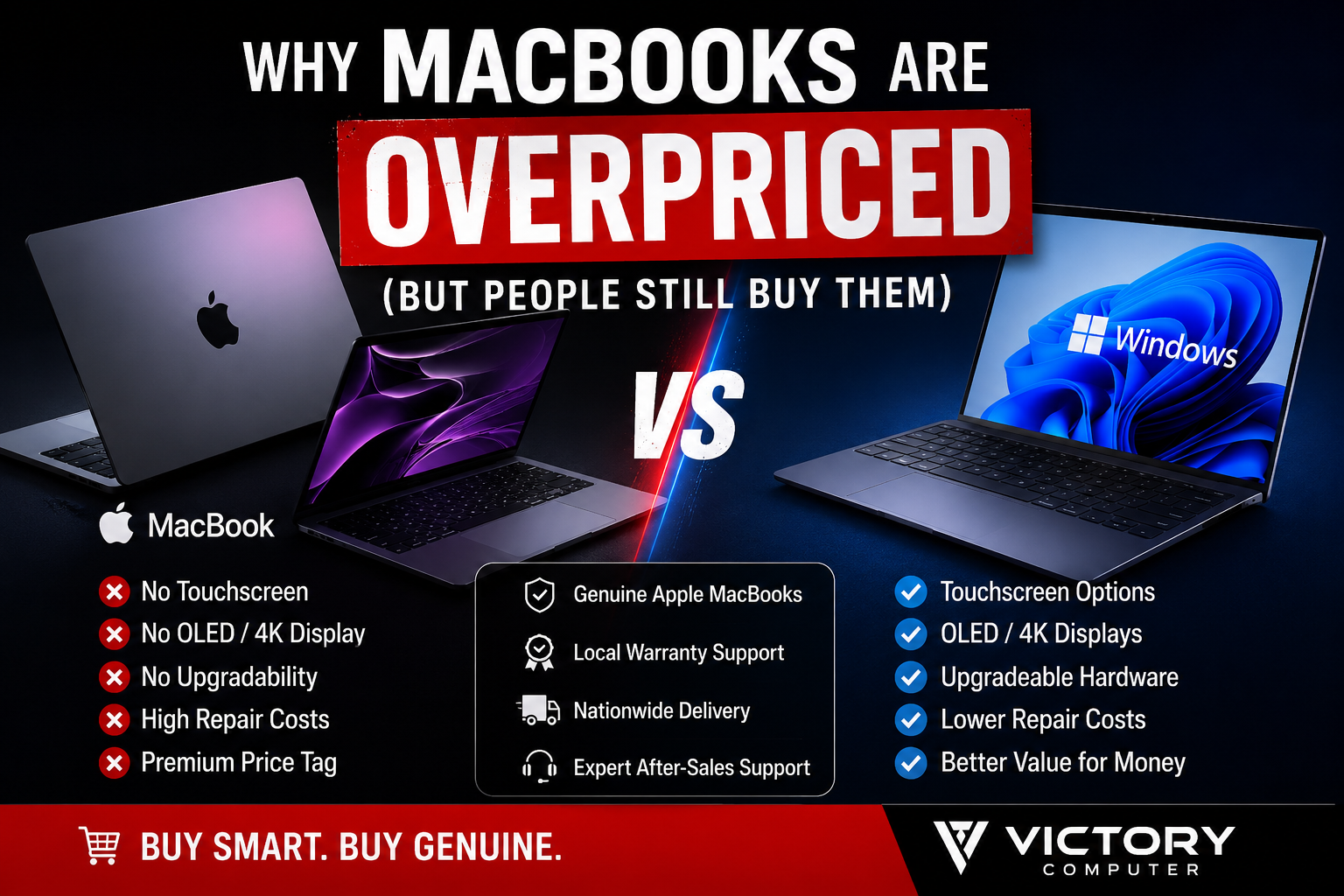
Why MacBooks Are Overpriced for What You Get
MacBooks are overpriced for some buyers because similarly priced Windows laptops can offer features Apple does not prioritize, including touchscreens, OLED panels, broader gaming compatibility and more hardware choices. But price-to-specification comparisons tell only part of the story. MacBooks remain attractive because of battery life, build quality, Apple Silicon performance, macOS and integration with other Apple devices.
Why MacBooks Are Overpriced for Some Buyers
The argument that MacBooks are overpriced becomes strongest when you judge a laptop mainly by the hardware features you receive for your money. Windows manufacturers compete across a much wider range of configurations, screen technologies, GPUs and form factors.
Depending on budget and model, Windows buyers can find OLED displays, touchscreens, convertible 2-in-1 designs, dedicated NVIDIA graphics and gaming-focused high-refresh-rate screens. Apple takes a different approach, offering a relatively small MacBook lineup built around tightly integrated hardware and macOS.
MacBook Air is a good example. Apple’s M4-generation 13-inch MacBook Air uses a 13.6-inch 2560 × 1664 LED-backlit IPS Liquid Retina display with 500-nit brightness rather than OLED. Apple also lists 16GB unified memory as standard on that generation, configurable to 24GB or 32GB, with SSD configurations reaching 2TB.
The important point is therefore not that MacBooks have poor hardware. They do not. The issue is that buyers paying premium-laptop money may value features that competing Windows machines provide and Apple does not.
What Do You Actually Get for the Apple Premium?
Apple’s premium becomes easier to understand when the MacBook is considered as a complete system rather than a checklist of individual specifications.
Apple Silicon combines the CPU, GPU, Neural Engine and unified memory architecture into a tightly controlled hardware and software platform. That integration helps Apple optimize macOS around a relatively small number of hardware configurations.
Battery life is another major advantage. Apple rates the 13-inch M4 MacBook Air for up to 18 hours of video streaming and up to 15 hours of wireless web use. The 14-inch M4 MacBook Pro is rated for up to 24 hours of video streaming and up to 16 hours of wireless web use. Actual battery life varies with workload and configuration, but Apple’s official figures illustrate why battery endurance remains an important part of the MacBook value proposition.
The MacBook Pro also addresses one criticism sometimes applied too broadly to MacBooks. Current Pro models are not limited to basic 60Hz displays: the 14-inch M4 MacBook Pro has a 3024 × 1964 Liquid Retina XDR display with ProMotion adaptive refresh rates up to 120Hz.
MacBook Pros and Cons
Pros
- Strong battery efficiency: Apple Silicon MacBooks are designed around high performance per watt, making them attractive for mobile work.
- Premium construction: MacBooks use rigid aluminum enclosures with a clean, consistent design.
- macOS integration: Apple’s control over hardware and operating system provides a consistent computing environment.
- Excellent displays: MacBook Air offers a sharp Liquid Retina panel, while MacBook Pro adds Liquid Retina XDR and ProMotion up to 120Hz.
- Apple ecosystem: MacBooks work closely with products and services across Apple’s device ecosystem.
Cons
- No touchscreen MacBook: Buyers who need touch or convertible laptop functionality should consider Windows alternatives.
- No OLED MacBook display: Buyers specifically wanting OLED can find numerous Windows options.
- Limited post-purchase upgrades: Memory and internal storage configuration should be chosen carefully at purchase because modern MacBooks are not designed around conventional user-upgradeable RAM and SSD modules.
- Gaming limitations: Windows remains the more flexible choice for buyers whose priority is broad PC game compatibility and dedicated gaming hardware.
- Premium configurations become expensive: Increasing memory and storage can significantly change the overall value equation.
Why We Recommend It
A MacBook makes the most sense for buyers who prioritize battery life, portability, macOS, build quality and Apple’s ecosystem over maximum specifications per rupee. Buyers who prioritize gaming, touchscreen functionality, OLED, hardware choice or maximum performance-per-rupee should compare business laptops in Pakistan and other Windows alternatives before deciding.
MacBook vs Windows Laptop: Which Gives You More for Your Money?
Windows generally offers more hardware choice, while MacBooks offer a more controlled hardware-software experience. The better value therefore depends on what the buyer actually needs.
| Priority | MacBook | Windows Laptop |
|---|---|---|
| Battery-focused productivity | Excellent choice | Varies considerably by model |
| Touchscreen | Not available on MacBook | Widely available |
| OLED options | Not currently offered on MacBook | Available on many premium models |
| PC gaming | More limited game selection | Generally stronger choice |
| Hardware variety | Limited, controlled lineup | Very broad selection |
| Apple ecosystem | Major advantage | Not equivalent |
| macOS-specific workflows | Required | Not available natively |
For gaming in particular, buyers should compare current gaming laptops in Pakistan. A Windows gaming laptop with dedicated NVIDIA graphics can be a more appropriate purchase than a MacBook when gaming is the primary requirement.
Budget-conscious buyers should also compare budget laptops in Pakistan instead of assuming a premium notebook is necessary for everyday browsing, Microsoft Office, online classes and general productivity.
Why Do People Still Buy MacBooks?
People continue buying MacBooks because a laptop’s value is not determined solely by how many features appear on its specification sheet. For the right user, the combination of battery efficiency, macOS, portability, build quality and Apple-device integration can justify the higher purchase cost.
1. Battery Life Matters More Than an Extra Specification
A laptop that remains usable away from a charger can be more valuable to a student, freelancer or travelling professional than a machine with a more impressive specification sheet but poorer endurance.
2. macOS Is Part of the Purchase
A MacBook buyer is buying access to macOS as much as the physical computer. Users who prefer Apple’s operating system or depend on Mac-specific workflows cannot judge value simply by comparing CPU, RAM and SSD numbers with a Windows machine.
3. Apple Controls the Hardware and Software
The limited number of Mac configurations can look restrictive, but it also gives Apple tighter control over the platform. The same restriction that reduces hardware choice can contribute to a more predictable hardware-software environment.
4. The Ecosystem Has Practical Value
For people already using an iPhone or other Apple products, the Mac can become part of a broader workflow. That ecosystem value is difficult to express in a conventional specifications table.
5. Design and Portability Matter
MacBook Air remains particularly attractive to buyers who want a thin, light laptop without moving to a low-power budget platform. That is one reason MacBooks remain popular with students and mobile professionals even when cheaper Windows alternatives exist.
Who Should Buy a MacBook?
Choose a MacBook if your priorities are macOS, battery efficiency, portability, premium construction and Apple ecosystem integration.
A MacBook Air is particularly suited to students, office users, freelancers and professionals whose workloads do not require a dedicated gaming GPU. MacBook Pro is aimed at more demanding professional workflows and adds features such as the Liquid Retina XDR display, ProMotion and a broader selection of ports.
MacBook Pro models also include ports such as HDMI and SDXC alongside Thunderbolt connectivity, so the old criticism that every modern MacBook provides almost no physical connectivity no longer applies equally across Apple’s lineup.
Who Should Choose Windows Instead?
Choose Windows when hardware flexibility or a specific feature matters more than Apple’s ecosystem.
- You want an OLED laptop.
- You need a touchscreen or 2-in-1 convertible.
- PC gaming is a major priority.
- You need NVIDIA GeForce RTX graphics for a particular workflow.
- You want the widest possible selection at a specific budget.
- You depend on Windows-only applications or peripherals.
Software compatibility deserves particular attention. Apple’s transition to Apple Silicon changed how Windows can be used on modern Macs, so buyers who depend heavily on Windows should understand the Boot Camp and Windows situation on modern Macs before purchasing.
Are MacBooks Worth the Price in Pakistan?
For Pakistani buyers, a MacBook can be worth the price when its specific advantages match the intended workload. It becomes poor value when the buyer pays for Apple’s premium design and ecosystem but actually needs features better served by a Windows laptop.
Before purchasing, compare the exact model, memory, SSD capacity, keyboard configuration and warranty terms. Imported configurations can differ, so the model and warranty should be confirmed rather than assumed from the product family name alone.
Current availability and configurations can be checked through Victory Computer. Because laptop pricing changes with model, configuration and market conditions, compare the current selling price rather than relying on an old price quoted in a blog article.
Final Verdict: Are MacBooks Overpriced?
MacBooks are overpriced if you judge value mainly by hardware features per rupee. Windows manufacturers can offer touchscreens, OLED displays, dedicated gaming GPUs and a wider selection of configurations that may deliver more obvious hardware for the money.
But that does not make MacBooks poor-value computers for everyone. Apple sells a tightly integrated combination of hardware, macOS, battery efficiency, premium construction and ecosystem features. For buyers who value those advantages, the premium can be reasonable.
The better question is therefore not simply, “Why are MacBooks so expensive?” It is: Are you paying for MacBook advantages you will actually use?
If the answer is yes, a MacBook can be worth buying. If your priorities are gaming, OLED, touch input, broad hardware choice or maximum specifications for your budget, Windows will usually give you more options.
Frequently Asked Questions
Why are MacBooks more expensive than many Windows laptops?
Apple competes on the combination of its own silicon, macOS, industrial design, displays, battery efficiency and ecosystem rather than trying to offer the highest specification in every category for the lowest price.
Are MacBooks overpriced compared with Windows laptops?
They can be if your priority is hardware features per rupee. Windows laptops offer a broader range of OLED, touchscreen, gaming and dedicated-GPU configurations.
What are the biggest disadvantages of a MacBook?
The main trade-offs include no touchscreen, no OLED MacBook option, limited post-purchase hardware upgrades and weaker compatibility with many PC games compared with Windows.
Is a MacBook good for students?
Yes, particularly for students who prioritize battery life, portability and macOS. Students who require Windows-specific engineering software or want gaming capability should verify compatibility before buying.
Is MacBook Pro better than a Windows laptop?
Neither is universally better. MacBook Pro is strong for macOS-based professional workflows, battery efficiency and Apple’s ecosystem, while Windows offers more hardware configurations, gaming choices and specialist options.
Should I buy a MacBook or Windows laptop in Pakistan?
Choose according to software requirements and workload first, then compare the current price of suitable configurations. Do not pay the MacBook premium unless its macOS, battery, portability or ecosystem advantages benefit your actual use.
Lorem ipsum dolor sit amet, consectetur adipiscing elit. Ut elit tellus, luctus nec ullamcorper mattis, pulvinar dapibus leo.
One thought on “Why MacBooks Are Overpriced for What You Get (But People Still Buy Them) | Expert Review”