
AMD Ryzen 3 vs Ryzen 5 vs Ryzen 7 vs Ryzen 9: Complete Comparison Guide

AMD Ryzen 3 vs Ryzen 5 vs Ryzen 7 vs Ryzen 9: Complete Comparison Guide
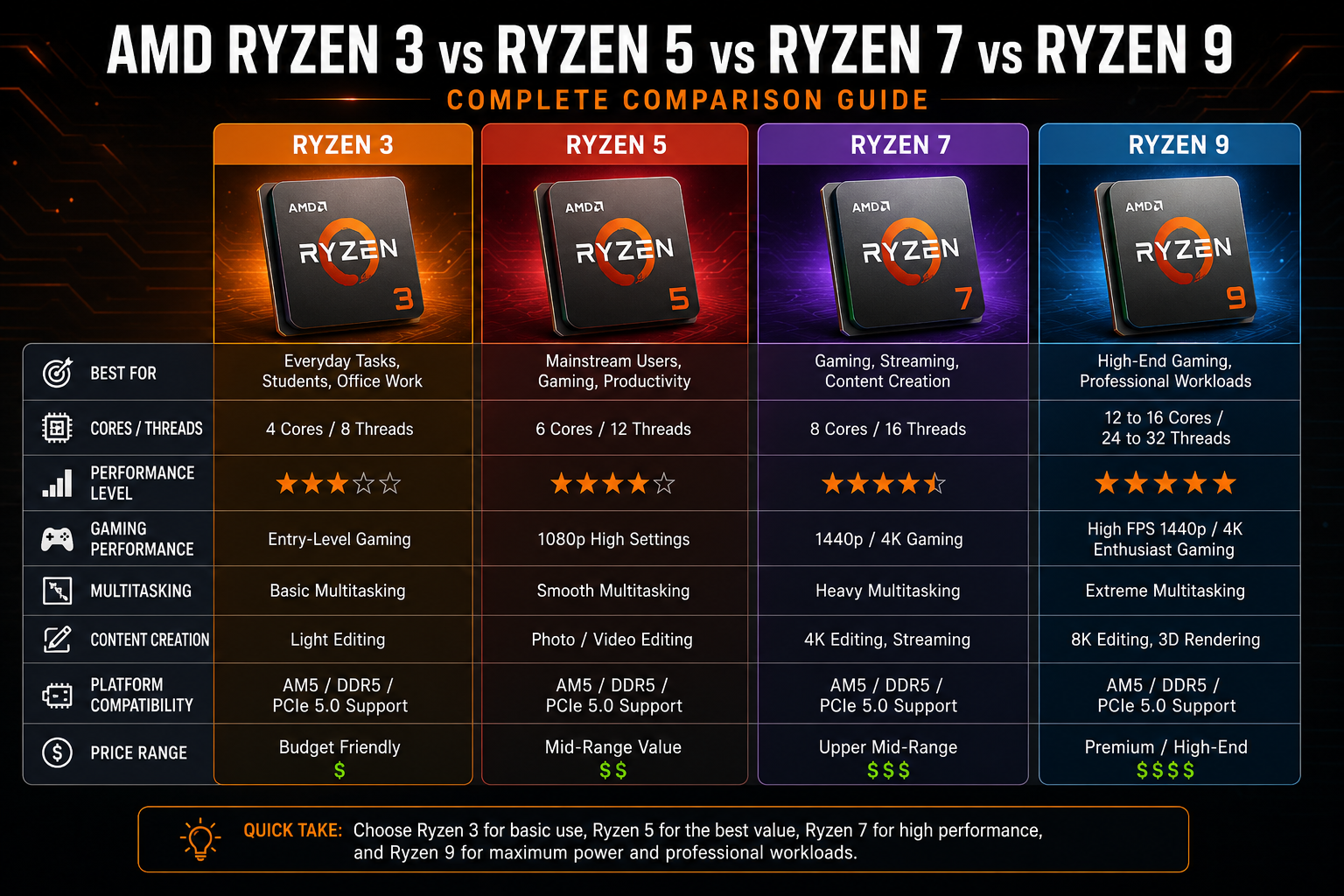
AMD Ryzen 3 vs Ryzen 5 vs Ryzen 7 vs Ryzen 9 mainly comes down to workload and budget. Ryzen 3 targets everyday computing, Ryzen 5 is the mainstream all-rounder, Ryzen 7 suits demanding gaming and multitasking, while Ryzen 9 targets enthusiasts and heavily threaded professional work. However, the exact model and generation matter just as much as the Ryzen tier.
Ryzen 3 vs Ryzen 5 vs Ryzen 7 vs Ryzen 9 at a Glance
The simplest way to understand the Ryzen hierarchy is to treat each number as a market tier rather than a guaranteed specification. Moving upward generally gives buyers access to processors positioned for increasingly demanding workloads, but generation, architecture, power limits, cache and the exact model can significantly affect performance.
| Ryzen Tier | Best For | Main Advantage | Main Trade-off |
|---|---|---|---|
| Ryzen 3 | Study, browsing, office work and basic home PCs | Lower-cost entry into Ryzen systems | Less suitable for demanding workloads |
| Ryzen 5 | Mainstream PCs, gaming and everyday multitasking | Strong balance of performance and cost | Heavy professional workloads may benefit from a higher tier |
| Ryzen 7 | Gaming, streaming, creation and heavier multitasking | More performance headroom | Higher system cost than mainstream options |
| Ryzen 9 | High-end PCs and heavily threaded professional workloads | Top-end Ryzen positioning and high multicore capability | Often unnecessary for normal users |
What Do Ryzen 3, Ryzen 5, Ryzen 7 and Ryzen 9 Mean?
Ryzen 3, Ryzen 5, Ryzen 7 and Ryzen 9 identify different positions within AMD's consumer processor family. They should not be treated as fixed core-count definitions because AMD specifications change between desktop, laptop and processor generations.
For example, AMD's current processor catalog spans several generations and product families, while AMD's Zen architecture has evolved substantially since the original Ryzen generation. Ryzen 9000 desktop processors use Zen 5 architecture, whereas earlier Ryzen generations can use Zen 4, Zen 3 or older architectures.
This means a newer Ryzen 5 can sometimes be a smarter purchase than an older Ryzen 7. Buyers should compare the full processor model, generation, architecture and intended power class rather than choosing only by the Ryzen 3, 5, 7 or 9 badge.
AMD Ryzen 3: Who Should Buy It?
Ryzen 3 is primarily suitable for buyers whose workload is light and predictable. Typical tasks include web browsing, Microsoft Office, online classes, video playback, email and general home computing.
Current AMD products demonstrate why specifications must be checked individually. For example, AMD lists the Ryzen 3 210 with 4 CPU cores and 8 threads, but that does not mean every Ryzen 3 ever released has the same configuration.
Ryzen 3 Pros
- Suitable for everyday computing
- Good fit for students and basic office systems
- Can reduce the cost of a complete PC or laptop
- A sensible option when demanding CPU performance is unnecessary
Ryzen 3 Cons
- Limited headroom for demanding creation and workstation workloads
- Usually less attractive for high-performance gaming systems
- May become restrictive sooner for users with growing workloads
Why We Recommend It
Choose Ryzen 3 when affordability and basic computing are the priorities. Buyers expecting gaming, frequent content creation or heavy multitasking should generally start their comparison with Ryzen 5 instead. You can also explore budget laptops in Pakistan when overall system cost matters more than maximum CPU performance.
AMD Ryzen 5: The Mainstream Choice
Ryzen 5 is usually the most practical tier for users who want considerably more flexibility than an entry-level processor without automatically paying for enthusiast-class hardware.
Ryzen 5 processors appear across many AMD generations and system types. As one desktop example, AMD's Ryzen 9000 family includes six-core, 12-thread Ryzen 5 models. Laptop Ryzen 5 specifications can differ because mobile processors are designed around different thermal and power requirements.
A well-selected Ryzen 5 system can handle office applications, programming, multitasking, mainstream gaming and many everyday creative workloads comfortably when paired with appropriate RAM, storage and graphics hardware.
Ryzen 5 Pros
- Strong balance between performance and system cost
- Suitable for mainstream gaming systems
- Good general-purpose multitasking capability
- Broad choice across laptops and desktops
Ryzen 5 Cons
- Heavy rendering and professional multicore workloads may benefit from Ryzen 7 or Ryzen 9
- Performance varies considerably between generations and laptop power classes
Why We Recommend It
Ryzen 5 is the logical starting point for most buyers who want one computer for work, study, entertainment and gaming. It usually makes more sense to buy a strong current-generation Ryzen 5 and a balanced overall system than to choose an older higher-tier CPU simply because its model name says Ryzen 7.
AMD Ryzen 7: Gaming and Heavy Multitasking
Ryzen 7 targets buyers who need more performance headroom for demanding gaming systems, streaming, software development, multitasking and content-creation workloads.
AMD's current lineup illustrates the tier's higher positioning. The Ryzen 7 9700X desktop processor, for example, is an 8-core, 16-thread Zen 5 model, while mobile Ryzen 7 products have specifications designed for laptop power and thermal requirements.
The extra capability becomes more useful when several demanding applications are running together or software can take advantage of additional CPU resources.
Ryzen 7 Pros
- Well suited to higher-performance gaming PCs
- Strong multitasking capability
- Better fit for streaming and creation than entry-level tiers
- Provides useful performance headroom for demanding users
Ryzen 7 Cons
- Costs more than Ryzen 5 systems
- Extra performance may be wasted on basic office workloads
- A Ryzen 7 badge alone does not guarantee better performance than every newer Ryzen 5
Why We Recommend It
Ryzen 7 is particularly attractive for users building a performance-oriented computer that must handle both gaming and serious productivity. For laptop buyers, compare the complete configuration rather than the processor alone; Victory Computer's gaming laptops in Pakistan category provides a useful starting point for complete gaming systems.
AMD Ryzen 9: Who Actually Needs It?
Ryzen 9 is AMD's high-end Ryzen tier for users who can genuinely benefit from substantial multicore performance or want an enthusiast-class system.
Current desktop examples demonstrate the difference. AMD lists Ryzen 9000 Series Ryzen 9 processors with up to 16 cores and 32 threads, while the Ryzen 7 9700X has 8 cores and 16 threads and Ryzen 5 9600-series models have 6 cores and 12 threads.
That additional CPU capacity can matter in rendering, compilation, professional creation, heavy multitasking and other highly threaded workloads. It does not mean Ryzen 9 automatically provides twice the gaming experience of Ryzen 5 or Ryzen 7.
Ryzen 9 Pros
- High multicore capability on suitable models
- Designed for demanding enthusiast and professional workloads
- Excellent choice for users who regularly run CPU-intensive software
- More performance headroom for heavily threaded work
Ryzen 9 Cons
- Higher processor and overall system cost
- Unnecessary for browsing, study and normal office work
- Gaming alone does not always justify moving from Ryzen 7 to Ryzen 9
Why We Recommend It
Ryzen 9 makes sense when your applications can use its additional resources or when you are building a high-end workstation or enthusiast PC. Mainstream buyers should avoid paying for unused CPU capability and put the budget toward other important components where appropriate.
Ryzen 3 vs Ryzen 5: Which Is Better?
Ryzen 5 is generally the better choice for users who need more than basic computing. Ryzen 3 remains appropriate for light workloads, while Ryzen 5 gives buyers more flexibility for multitasking, gaming and longer-term use.
If the computer will mainly run browsers, office applications, online classes and media, Ryzen 3 can be sufficient. If gaming, programming, heavier multitasking or more demanding applications are expected, Ryzen 5 is usually the safer tier to consider.
Ryzen 5 vs Ryzen 7: Is Ryzen 7 Worth It?
Ryzen 7 is worth considering when the workload can use the additional performance; otherwise, Ryzen 5 often provides better overall value.
For a gaming PC, the decision also depends on the graphics card, resolution and exact CPU model. Spending more on Ryzen 7 while compromising heavily on the GPU can produce a poorly balanced gaming system.
For streaming, editing, demanding productivity or frequent multitasking, the move from Ryzen 5 to an appropriate Ryzen 7 becomes easier to justify.
Ryzen 7 vs Ryzen 9: Do You Need Ryzen 9?
Most mainstream users do not need Ryzen 9. Ryzen 7 already occupies a high-performance position and can be an excellent choice for gaming and serious productivity, while Ryzen 9 becomes more compelling for heavily threaded professional workloads and enthusiast systems.
For users who spend substantial time rendering, compiling or running CPU-intensive professional applications, the higher-end tier can save meaningful processing time. For normal gaming and everyday productivity, that additional investment may deliver less practical benefit.
Which Ryzen Processor Is Best for Gaming?
Ryzen 5 and Ryzen 7 are generally the tiers most gaming buyers should compare first, but the exact processor matters more than the badge alone. AMD also offers gaming-focused X3D processors using 3D V-Cache technology, so a gaming decision should consider cache design, architecture and generation alongside the Ryzen tier.
A gaming PC also depends heavily on the graphics card. At higher resolutions or visually demanding settings, GPU selection can have a major influence on overall gaming performance. A balanced Ryzen 5 or Ryzen 7 system with the appropriate graphics card can therefore make more sense than spending disproportionately on the CPU.
For a broader platform comparison, read our Intel vs AMD desktop processors for gaming guide.
What About Ryzen Processors in Laptops?
Laptop Ryzen processors require extra care because Ryzen 3, Ryzen 5, Ryzen 7 and Ryzen 9 systems can use different generations, architectures and power classes. Cooling design and manufacturer power configuration can also influence sustained laptop performance.
AMD's Ryzen laptop processor lineup includes multiple families, so two laptops carrying similar Ryzen tier labels should not automatically be treated as equivalent.
Compare the complete model number together with RAM, storage, graphics, display, cooling and battery requirements. Buyers comparing the two major CPU brands can also read our Intel vs AMD laptops comparison.
Does Processor Generation Matter More Than Ryzen Tier?
Generation can matter enough that you should never compare Ryzen processors by tier alone. AMD's desktop Ryzen architecture has progressed from the original Zen architecture through Zen 2, Zen 3, Zen 4 and Zen 5.
New generations can change architecture, efficiency, platform support, cache design and performance characteristics. For example, AMD's Ryzen 9000 desktop family uses Zen 5 and supports technologies including DDR5 and PCIe 5.0 on the AM5 platform.
Always compare processors using the complete model number. “Ryzen 7” tells you the market tier; it does not tell you everything about the CPU.
Which Ryzen Processor Should You Buy?
The best choice in the AMD Ryzen 3 vs Ryzen 5 vs Ryzen 7 vs Ryzen 9 comparison depends on what you actually plan to do with the computer.
| User / Workload | Recommended Starting Tier |
|---|---|
| Basic browsing and home use | Ryzen 3 |
| Students and general productivity | Ryzen 3 / Ryzen 5 |
| Programming and mainstream multitasking | Ryzen 5 |
| Mainstream gaming | Ryzen 5 / Ryzen 7 |
| Gaming + streaming | Ryzen 7 |
| Content creation | Ryzen 7 / Ryzen 9 depending on workload |
| Heavy rendering and professional multicore work | Ryzen 9 |
For most users, Ryzen 5 is the sensible starting point. Ryzen 3 is appropriate when computing needs are basic, Ryzen 7 provides additional headroom for demanding users, and Ryzen 9 should be purchased when high-end workloads can genuinely use its additional resources.
Most importantly, compare the exact CPU rather than buying solely by the Ryzen number. A balanced system with suitable RAM, storage, graphics and cooling is usually more useful than spending the entire budget on a higher processor tier.
Buyers building a complete computer can browse desktop PCs in Pakistan, while laptop buyers can compare available configurations through Victory Computer.
Frequently Asked Questions
Is Ryzen 5 better than Ryzen 3?
Ryzen 5 generally occupies a higher performance tier than Ryzen 3 and is better suited to gaming, multitasking and more demanding applications. Compare the exact models and generations before buying.
Is Ryzen 7 worth it over Ryzen 5?
Ryzen 7 can be worth the additional cost for demanding gaming, streaming, creation and heavier multitasking. Ryzen 5 is often sufficient for mainstream users.
Is Ryzen 9 better than Ryzen 7 for gaming?
Not automatically. Gaming performance depends on the exact CPU architecture, cache, clock behavior, game and GPU, and AMD's X3D models can change the normal tier comparison significantly.
Is Ryzen 5 enough for gaming?
Yes, an appropriate current Ryzen 5 can be an excellent gaming CPU. GPU choice, resolution and the specific Ryzen 5 model must also be considered.
Which Ryzen processor is best for students?
Ryzen 3 can handle basic study and office workloads, while Ryzen 5 is the stronger choice for students who also program, multitask, edit content or play games.
Which is best: Ryzen 3, Ryzen 5, Ryzen 7 or Ryzen 9?
There is no universal winner. Ryzen 3 suits basic computing, Ryzen 5 offers mainstream versatility, Ryzen 7 targets demanding gaming and productivity, and Ryzen 9 is best reserved for users who need high-end multicore performance.