
Intel Integrated Graphics vs AMD Integrated Graphics

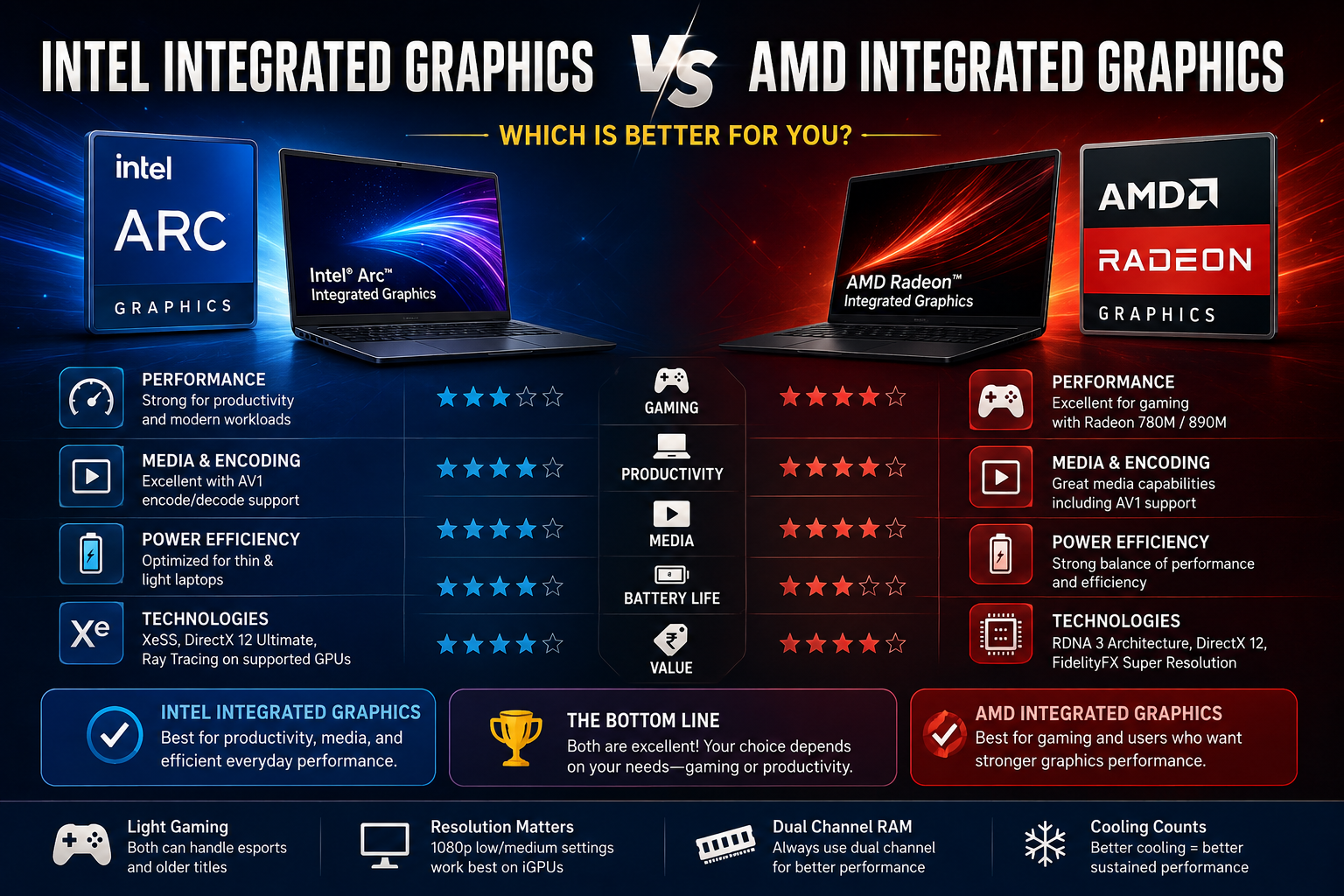
Intel Integrated Graphics vs AMD Integrated Graphics: Which Is Better?
Intel Integrated Graphics vs AMD Integrated Graphics is no longer a simple comparison where AMD automatically wins. Modern AMD Radeon 780M/890M graphics and newer Intel Arc integrated GPUs can both handle everyday computing, media and light gaming well. AMD remains a strong gaming-oriented choice, while Intel's latest Arc solutions have made the competition much closer.
Intel Integrated Graphics vs AMD Integrated Graphics: Quick Verdict
AMD Radeon integrated graphics are an excellent option for buyers prioritizing gaming without a dedicated GPU, but newer Intel Arc integrated graphics are now serious competitors. The correct choice depends heavily on the exact processor, laptop power limits, memory configuration, cooling and workload.
Do not buy a laptop based only on the Intel or AMD logo. Compare the exact CPU and GPU configuration. A modern Intel Core Ultra laptop with capable Arc graphics can be considerably different from an older Intel UHD system, just as a Ryzen processor with Radeon 890M is different from an entry-level AMD processor with a smaller integrated GPU.
What Are Integrated Graphics?
Integrated graphics are graphics processing hardware included within the processor or processor package rather than supplied through a separate dedicated graphics card. Integrated GPUs generally use system memory instead of having a large pool of dedicated VRAM.
The main benefit is efficiency. Laptop manufacturers can build thinner, lighter and often more affordable computers without installing a separate NVIDIA or AMD discrete GPU.
Modern integrated graphics can comfortably handle Windows, web browsing, office applications, video playback, multiple displays and many creative workloads. More capable models can also run games, particularly when resolution and graphics settings are adjusted appropriately.
Intel Integrated Graphics vs AMD Integrated Graphics Comparison
| Area | Modern Intel Integrated Graphics | Modern AMD Integrated Graphics |
|---|---|---|
| Everyday productivity | Excellent | Excellent |
| Video and streaming | Strong media capabilities | Strong media capabilities |
| Casual gaming | Good on capable Arc configurations | Very good on stronger Radeon configurations |
| Modern examples | Intel Arc 140V and newer Arc variants | Radeon 780M and Radeon 890M |
| Dedicated VRAM | No, normally uses shared system memory | No, normally uses shared system memory |
| Best choice | Depends on exact Core Ultra configuration and workload | Strong choice for gaming-focused iGPU laptops |
The biggest mistake in an Intel Integrated Graphics vs AMD Integrated Graphics comparison is treating every Intel GPU or every AMD GPU as identical. Both manufacturers sell processors across several performance classes.
Which Integrated Graphics Are Better for Gaming?
AMD remains particularly attractive for integrated-graphics gaming, although modern Intel Arc graphics have narrowed the difference significantly.
AMD's Ryzen 7 8840U, for example, officially includes Radeon 780M graphics with 12 graphics cores. Higher-end Ryzen AI processors can include Radeon 890M graphics with 16 graphics cores. AMD lists DirectX 12 support on both examples.
Intel has also moved well beyond the basic integrated graphics associated with many older office laptops. Intel's Core Ultra 7 256V, for example, includes an Arc 140V GPU with eight Xe cores, DirectX support, ray-tracing capabilities and hardware AV1 encode/decode support.
This means the answer cannot simply be "AMD always wins." Intel Arc integrated graphics can provide meaningful gaming capability in appropriately configured Core Ultra laptops.
Actual frame rates vary significantly with the processor, memory bandwidth, laptop cooling, power limits, drivers, resolution and game. For that reason, buyers should compare independent benchmarks of the exact laptop models they are considering rather than relying on the processor brand alone.
For demanding AAA gaming at high resolutions and settings, integrated graphics still should not be treated as a universal replacement for a dedicated gaming GPU. Readers targeting heavier gaming should compare budget graphics cards for 1080p gaming or browse gaming laptops in Pakistan.
AMD Radeon Integrated Graphics Explained
AMD's strongest advantage is the availability of capable Radeon graphics inside several Ryzen mobile processors. AMD has continued developing its integrated GPU architecture alongside its desktop Radeon technology.
The Ryzen 7 8840U officially includes Radeon 780M graphics, while the Ryzen AI 9 HX 370 includes Radeon 890M graphics. The latter has 16 graphics cores and operates at up to 2900 MHz according to AMD's specifications. AMD's newer Ryzen AI 400 family also includes configurations using Radeon 890M graphics.
This makes higher-end AMD APUs particularly interesting for compact laptops and systems intended to provide useful graphics capability without the cost, heat and power requirements associated with a discrete GPU.
AMD Integrated Graphics Advantages
- Strong graphics options in selected Ryzen processors
- Suitable for casual and lighter PC gaming
- Radeon 780M and 890M support modern graphics APIs
- Useful option for thin laptops without dedicated GPUs
- Good balance between CPU and graphics capability on selected processors
Intel Arc Integrated Graphics Explained
Intel's newer Arc integrated graphics represent a major change from the basic Intel graphics many buyers remember from older laptops. Select Core Ultra processors contain substantially more capable integrated graphics hardware.
Intel lists the Arc 140V GPU in processors such as the Core Ultra 7 256V. That configuration contains eight Xe cores and supports hardware H.264, H.265 and AV1 encoding and decoding. Intel also supports technologies such as XeSS across compatible Arc hardware and software.
Intel's current lineup is important because not every Core Ultra processor contains the same graphics hardware. Some processors use Intel Graphics, while selected configurations receive more capable Intel Arc branding. Buyers therefore need to inspect the exact specification sheet.
Intel Integrated Graphics Advantages
- Strong everyday productivity and media capabilities
- Modern Arc variants offer significantly stronger graphics than basic Intel solutions
- Hardware acceleration for modern video codecs on supported models
- Useful gaming capability on selected Core Ultra laptops
- Well suited to thin productivity-focused laptops
Which Is Better for Productivity and Content Creation?
For normal productivity, there is no reason to choose a laptop solely because it uses Intel or AMD integrated graphics. Word processing, web applications, spreadsheets, video calls, presentations and everyday multitasking are comfortably within the capabilities of modern integrated GPUs.
Media workloads are also increasingly important. Modern Intel Arc integrated GPUs support hardware AV1 encode/decode on supported processors. AMD's Radeon 780M and 890M specifications likewise include hardware video capabilities including AV1.
Software support matters as much as raw GPU hardware for professional work. Before purchasing for a specific editing, CAD, rendering or AI application, check that application's recommended hardware and acceleration support.
Which Is Better for Battery Life and Thin Laptops?
Integrated graphics can improve portability because the laptop does not need to power a separate high-performance graphics processor for ordinary workloads. However, Intel versus AMD branding alone cannot predict battery life.
Battery capacity, display technology, screen brightness, CPU power settings, cooling design, memory, background applications and the laptop manufacturer's firmware all affect real-world endurance.
Intel's Core Ultra architecture can separate graphics, media and other functions across different parts of the processor package, while AMD combines capable Radeon graphics with mobile Ryzen processors designed for a range of laptop power envelopes. The final laptop design determines how effectively those technologies are used.
Should You Buy Intel or AMD Integrated Graphics?
Choose according to the exact GPU and your workload, not the manufacturer name.
| User | Recommended Direction | Reason |
|---|---|---|
| Office user | Intel or AMD | Both are more than capable for standard productivity |
| Student | Intel or AMD | Prioritize complete laptop value, battery and display |
| Casual gamer | AMD Radeon or capable Intel Arc | Modern versions provide useful gaming performance |
| iGPU-focused gamer | Consider higher-end AMD Radeon options | Radeon 780M/890M systems are strong candidates |
| Video/media user | Compare both | Both platforms offer modern media acceleration |
| Heavy AAA gamer | Dedicated GPU | A discrete gaming GPU remains the safer choice |
If the choice involves the complete CPU platform as well as graphics, our Intel vs AMD laptops comparison explains the wider buying decision. Desktop buyers can also read the Intel vs AMD desktop processors guide.
Intel vs AMD Integrated Graphics: Pros and Cons
Intel Integrated Graphics — Pros
- Very good for productivity and everyday computing
- Modern Arc versions provide much stronger gaming capability than older Intel solutions
- Strong media encode/decode support on current Arc hardware
- Available in many thin-and-light laptops
Intel Integrated Graphics — Cons
- Graphics capability varies considerably between processor models
- Intel Graphics, Intel UHD and Intel Arc should not be treated as equivalent
- High-end gaming still benefits from a dedicated GPU
AMD Integrated Graphics — Pros
- Strong Radeon integrated GPUs available in selected Ryzen processors
- Radeon 780M and 890M are attractive for gaming without a discrete GPU
- Modern multimedia and display capabilities
- Useful combination of CPU and GPU performance in compact laptops
AMD Integrated Graphics — Cons
- Not every Ryzen processor includes the same Radeon graphics configuration
- System memory and laptop power configuration can materially affect performance
- Demanding gaming still favors a suitable dedicated GPU
Why We Recommend Comparing the Exact GPU
The most useful Intel Integrated Graphics vs AMD Integrated Graphics buying rule is simple: compare GPU model against GPU model. Radeon 890M versus Arc 140V is a meaningful comparison; "AMD versus Intel" without processor models is not specific enough to predict performance.
Which Integrated Graphics Laptop Should You Buy in Pakistan?
Pakistani buyers should prioritize total laptop value rather than paying extra simply for one graphics brand. Processor model, RAM configuration, SSD capacity, display quality, cooling, battery capacity and warranty conditions can matter more than a small graphics difference.
Students and office users generally do not need a dedicated graphics card for normal study, browsing, Microsoft Office, programming and media consumption. A well-configured Intel or AMD laptop with integrated graphics can reduce cost and usually makes more sense than paying for graphics hardware that will rarely be used.
Gaming changes the decision. If you want an affordable machine capable of lighter gaming without a dedicated GPU, look closely at laptops equipped with stronger Radeon or Intel Arc integrated solutions. If modern AAA gaming is the priority, move toward a laptop with dedicated graphics instead.
You can compare budget laptops in Pakistan or explore Victory Computer when comparing current laptop options.
Final Verdict: Intel Integrated Graphics or AMD?
There is no universal winner in Intel Integrated Graphics vs AMD Integrated Graphics. AMD's stronger Radeon iGPUs remain excellent choices for buyers who want gaming capability without dedicated graphics. Intel's newer Arc integrated GPUs, however, have become genuinely competitive and should not be judged by the reputation of older Intel UHD graphics.
For office work, studying and general use, choose the better overall laptop. For integrated-graphics gaming, give particular attention to higher-end Radeon and Arc configurations. For demanding gaming, 3D rendering or GPU-heavy professional applications, consider a suitable dedicated graphics solution.
Frequently Asked Questions
Is AMD integrated graphics better than Intel?
AMD has several strong Radeon integrated GPUs, but modern Intel Arc integrated graphics have made the comparison much closer. The exact processor and GPU models should be compared before buying.
Is AMD Radeon 890M good for gaming?
Radeon 890M is one of AMD's higher-capability integrated graphics solutions and is designed to provide meaningful graphics performance without a separate GPU. Actual gaming performance depends on the laptop configuration and game settings.
Is Intel Arc integrated graphics good for gaming?
Yes. Modern integrated Intel Arc configurations can run many games, particularly with appropriate resolution and graphics settings. Performance varies between Arc GPU models and laptop designs.
Can integrated graphics run GTA, Valorant and esports games?
Many modern integrated GPUs can run popular esports and less demanding games. Resolution, settings, memory configuration and the exact GPU determine the final experience.
Do integrated graphics use RAM?
Yes. Integrated GPUs normally share system memory instead of relying on a large dedicated VRAM pool, making memory bandwidth and configuration relevant to graphics performance.
Do I need a dedicated GPU instead?
Choose a dedicated GPU for demanding AAA gaming, GPU-intensive 3D work or professional applications that specifically benefit from discrete graphics. Everyday users often do not need one.