
Cheapest Laptops in Pakistan: Are They Worth Buying?

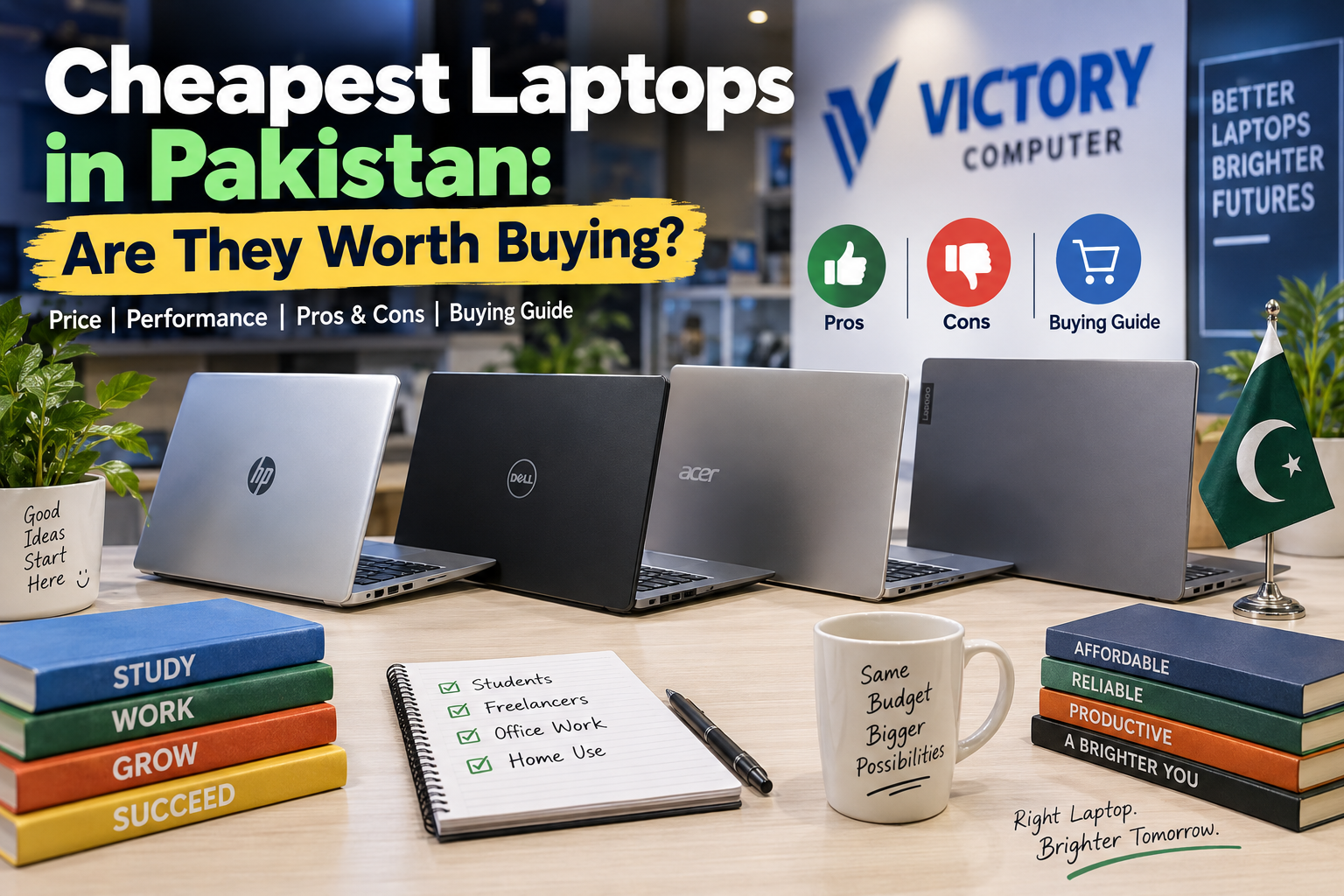
Cheapest Laptops in Pakistan
Finding the cheapest laptops in Pakistan can be tempting, especially for students, home users, freelancers, and small businesses working with a limited budget. But buying the lowest-priced laptop is not always the same as getting the best value.
A cheap laptop can be a sensible purchase when your requirements are limited to web browsing, Microsoft Office, online classes, email, video calls, accounting software, and other light applications. The problems begin when buyers expect an entry-level machine to perform like a Core i5, Core i7, Ryzen 5, or dedicated-GPU laptop.
Quick answer: Cheap laptops are worth buying when the hardware matches your actual workload. For most Windows users, we recommend prioritizing 8GB RAM, SSD storage, a reasonably modern processor, and a Full HD display rather than simply choosing the lowest price available.
What Does a Cheap Laptop Actually Mean in Pakistan?
There is no permanent price that defines a cheap laptop in Pakistan. Laptop prices can change because of model availability, exchange rates, imports, specifications, warranty coverage, and whether a machine is new, open-box, refurbished, or used.
It is therefore more useful to compare hardware and condition instead of buying according to price alone.
The lowest-cost new laptops commonly sit in the entry-level part of the market. Depending on the model, you may encounter Intel N-series processors, older entry-level Intel processors, basic AMD processors, integrated graphics, 4GB to 8GB of memory, and relatively small SSDs.
Buyers with a little more room in their budget can explore budget laptops with stronger processors, more memory, better displays, and larger SSDs. These generally provide better long-term value for work and study.
What Specifications Should You Look for in a Budget Laptop?
Do not judge an affordable laptop by its brand name alone. Two HP, Dell, Lenovo, Acer, or ASUS laptops at similar prices can deliver very different everyday performance.
| Component | Basic Use | Better Long-Term Choice |
|---|---|---|
| Processor | Modern entry-level CPU | Core i3/Core 3 or Ryzen 3-class and above |
| RAM | 4GB minimum for very light use | 8GB or more |
| Storage | 128GB SSD | 256GB/512GB SSD |
| Display | HD | Full HD IPS where possible |
| Graphics | Integrated graphics | Integrated graphics for normal productivity |
| Operating System | Depends on model | Windows 11-compatible hardware where Windows is required |
Microsoft lists 4GB RAM and 64GB storage among the minimum hardware requirements for Windows 11. Those are minimum requirements rather than specifications we would target for a comfortable multitasking experience. An 8GB RAM configuration with SSD storage is a much more practical starting point for a laptop you expect to use regularly.
What Can the Cheapest Laptops Handle?
A properly chosen entry-level laptop can handle more than many buyers expect. The key is keeping expectations realistic.
- Web browsing and online research
- Microsoft Word, Excel, and PowerPoint
- Email and basic office administration
- Zoom, Microsoft Teams, and online classes
- YouTube and streaming
- PDF documents and assignments
- Point-of-sale and basic business applications
- Light accounting and data-entry work
For a school or university student mainly working with documents, presentations, browsers, and video classes, an affordable laptop with enough RAM and SSD storage may be all that is required.
Where Do Cheap Laptops Start Struggling?
The limitations become more obvious with CPU-intensive, GPU-intensive, or memory-heavy workloads. Entry-level laptops are generally not designed for serious gaming, professional video editing, 3D rendering, engineering applications, large development environments, or heavy multitasking.
For example, keeping many browser tabs open while running Excel, Teams, and other applications can quickly expose the limitations of a 4GB machine. Likewise, integrated entry-level graphics should not be confused with the dedicated NVIDIA GeForce RTX GPUs found in gaming laptops.
If your work earns you money and depends on running demanding software efficiently, spending more on the right hardware can be more economical than replacing an underpowered laptop shortly after purchase.
Pros and Cons of Buying the Cheapest Laptops in Pakistan
Pros
- Lower initial cost: Entry-level laptops make computer ownership more accessible when the budget is limited.
- Suitable for basic work: Browsing, assignments, Office applications, email, and online classes do not always require expensive hardware.
- Lower hardware requirements for simple users: Paying for a powerful GPU or high-end processor makes little sense if you never use that performance.
- Good secondary-computer option: An affordable laptop can work well as a backup, travel, shop-counter, or basic office machine.
- Modern SSD-based models can feel responsive: Even inexpensive laptops can provide acceptable everyday responsiveness when paired with adequate RAM and SSD storage.
Cons
- Limited performance: Low-end processors and small amounts of RAM can struggle with demanding applications and heavy multitasking.
- Limited upgradeability: Some inexpensive laptops use soldered memory or offer fewer storage and memory upgrade options.
- Basic displays: Entry-level models may compromise on resolution, brightness, colour quality, or viewing angles.
- Shorter useful performance life: A laptop that barely meets your requirements today may become frustrating as applications and workloads become heavier.
Why We Recommend Choosing by Value, Not Just Price
The cheapest laptop makes sense for users with genuinely light workloads. If you plan to keep the machine for several years, multitask regularly, program, edit videos, or run demanding business software, paying more for additional RAM, a stronger processor, and better storage is usually the more sensible approach.
Cheap New Laptop vs Used Core i5 Laptop
This is one of the most important decisions for budget buyers in Pakistan. At a similar budget, you may have to choose between a basic brand-new laptop and an older used business-class laptop with a stronger processor.
| Factor | Cheap New Laptop | Used Business Laptop |
|---|---|---|
| Condition | New | Depends on previous use |
| Processor Performance | Often entry-level | Can be stronger depending on generation |
| Battery Condition | Generally less wear | Must be checked carefully |
| Build Quality | Depends on model | Business models can be well built |
| Warranty | Depends on seller/model | Often limited or seller-based |
| Risk | Generally easier to assess | Condition and repair history matter |
A used Core i5 laptop is not automatically better simply because it says Core i5. Processor generation, battery health, SSD condition, display condition, keyboard, ports, hinges, charger, BIOS status, and previous repair history all matter.
If buying used, inspect the machine carefully and verify the exact processor rather than relying on labels such as “Core i5 laptop.”
Who Should Buy a Cheap Laptop?
Students: A budget laptop can be a practical option for assignments, presentations, research, online learning, and everyday university work.
Home users: If the laptop is mainly for YouTube, browsing, email, banking, documents, and occasional video calls, expensive hardware may provide little additional value.
Basic office users: Reception desks, basic accounting, inventory entry, invoicing, and document processing can often run comfortably on modest hardware.
Writers and virtual assistants: Browser-based work, WordPress, email, Google Docs, and similar workloads generally do not require a gaming-class computer, although 8GB or more RAM is preferable for multitasking.
Who Should Avoid the Cheapest Laptops?
You should consider moving above the entry-level category if you regularly perform:
- Modern PC gaming
- Professional video editing
- 3D modelling and rendering
- Large programming or virtualization workloads
- Engineering and CAD work
- Professional graphics workloads
- Heavy spreadsheet and data workloads
- Continuous multitasking across demanding applications
These workloads benefit significantly from stronger processors, additional memory, faster storage, and—in some cases—a dedicated GPU.
8GB RAM vs 4GB RAM: Which Should You Buy?
If your budget permits it, choose 8GB RAM over 4GB for a Windows laptop intended for regular everyday use.
Four gigabytes meets Microsoft’s minimum Windows 11 memory requirement, but minimum requirements should not be treated as an ideal buying target. Browsers alone can consume significant memory once multiple tabs are open, and Windows plus background applications need memory as well.
Before buying, also check whether RAM can be upgraded. Some inexpensive laptops have soldered memory, which means the amount installed at purchase may be the amount you keep for the life of the machine.
SSD vs HDD in a Cheap Laptop
An SSD should be a priority. For most buyers, a lower-cost laptop with an SSD is preferable to a similarly positioned machine relying on an old mechanical hard drive as its primary system drive.
SSD storage improves boot times, application loading, file access, and overall responsiveness. Capacity also matters: 128GB can become restrictive once Windows, updates, applications, and personal files are installed. A 256GB or 512GB SSD gives considerably more breathing room.
How to Choose the Cheapest Laptop Without Wasting Money
- Define your workload first. Write down the applications you actually use.
- Check the exact processor model. Do not compare laptops using only Intel, AMD, Core i3, or Core i5 branding.
- Aim for at least 8GB RAM for regular Windows multitasking where your budget allows.
- Choose SSD storage. Prefer 256GB or more if you plan to store applications and personal files locally.
- Check the display. Full HD is preferable for documents, browsing, and media consumption.
- Check upgradeability. Confirm whether RAM and SSD capacity can be expanded.
- Verify condition and warranty. This is especially important with imported, open-box, and used machines.
- Compare total value. A slightly more expensive laptop can save money if it lasts longer and handles your workload properly.
Are the Cheapest Laptops in Pakistan Worth Buying?
Yes—but only for the right user. The cheapest laptops in Pakistan can provide good value for students, home users, writers, basic office staff, and anyone whose workload is primarily browser and document based.
They become poor value when low price forces you to compromise on the components you actually need. A laptop that constantly runs out of memory, storage, or processing power is not inexpensive if you have to replace it soon afterwards.
Instead of asking, “What is the cheapest laptop I can buy?” ask “What is the least expensive laptop that comfortably handles my work?” That small change in buying strategy can lead to a much better purchase.
Buyers comparing affordable options can explore Victory Computer’s budget laptop range and compare specifications before deciding. Prices and availability can change, so check the current listing and exact configuration rather than relying on an old price guide.
Frequently Asked Questions
What is the lowest price of a laptop in Pakistan?
There is no single permanent lowest price because laptop pricing changes with specifications, condition, imports, exchange rates, and availability. Compare current listings and verify whether the machine is new, used, refurbished, or open-box.
Is 4GB RAM enough for a cheap laptop?
4GB meets the minimum memory requirement for Windows 11, but 8GB is a more practical target for regular browsing, Office applications, video calls, and multitasking.
Should I buy a cheap new laptop or a used Core i5 laptop?
A used Core i5 can provide stronger performance in some cases, but generation and condition matter. Check battery health, storage health, display, keyboard, ports, repair history, and Windows 11 compatibility before buying.
Can a cheap laptop handle Zoom and Microsoft Office?
Yes. A properly configured entry-level laptop can handle video calls, documents, presentations, spreadsheets, and browser-based work, although 8GB RAM is preferable when several applications are open simultaneously.
Can I use a cheap laptop for gaming?
Basic and older games may run on some entry-level laptops, but modern demanding games generally require substantially stronger CPU and graphics performance. Consider a gaming laptop if gaming is one of your main requirements.
What should I check before buying a budget laptop in Pakistan?
Check the exact processor, RAM, SSD capacity, display, upgradeability, battery, operating system, condition, and applicable warranty. Compare the complete configuration rather than selecting a laptop based only on price or brand.
Final Verdict
The cheapest laptops in Pakistan are worth buying when your requirements are simple and the hardware is adequate for them. Students, home users, writers, and light office users do not necessarily need an expensive laptop.
For a Windows laptop intended for regular use, prioritize 8GB RAM, SSD storage, a suitable modern processor, and a Full HD display where your budget allows. If gaming, editing, programming, engineering, or demanding professional work is part of your workload, moving to a stronger laptop is usually a better long-term investment.
Verdict: Buy the cheapest laptop that meets your requirements—not simply the cheapest laptop on the shelf.